Interoperability
HL7 ADT message types: the full list of A01 to A62 events
HL7 v2 ADT (admit, discharge, transfer) messages are identified by a trigger event code in HL7 table 0003, from A01 (admit/visit notification) to A62 (cancel change consulting doctor). The ones most hospitals rely on are A01 admit, A02 transfer, A03 discharge, A04 register, A05 pre-admit, A08 update patient information, their cancellations (A11, A12, A13), A28/A31 add and update person, and A40 merge patient. Several older merge events, including A18, A30, A34, A35, A36 and A39, are now marked deprecated.
The full list
Names are HL7's own, from table 0003 in HL7 Terminology. Every event here is answered with a general acknowledgement (ACK) except A19, which was a query.
| Code | HL7 name |
|---|---|
| A01 | Admit/visit notification |
| A02 | Transfer a patient |
| A03 | Discharge/end visit |
| A04 | Register a patient |
| A05 | Pre-admit a patient |
| A06 / A07 | Change an outpatient to an inpatient / an inpatient to an outpatient |
| A08 | Update patient information |
| A09 / A10 | Patient departing / arriving (tracking) |
| A11 / A12 / A13 | Cancel admit/visit / cancel transfer / cancel discharge |
| A14 / A15 / A16 | Pending admit / transfer / discharge |
| A17 | Swap patients |
| A18 | Merge patient information (deprecated) |
| A19 | Patient query (QRY/ADR, deprecated) |
| A20 | Bed status update |
| A21 / A22 | Patient goes on / returns from a leave of absence |
| A23 | Delete a patient record |
| A24 | Link patient information |
| A25 / A26 / A27 | Cancel pending discharge / transfer / admit |
| A28 / A29 | Add / delete person information |
| A30 | Merge person information (deprecated) |
| A31 | Update person information |
| A32 / A33 | Cancel patient arriving / departing (tracking) |
| A34 / A35 / A36 | Merge patient information: patient ID only / account number only / both (all deprecated) |
| A37 | Unlink patient information |
| A38 | Cancel pre-admit |
| A39 | Merge person: patient ID (deprecated) |
| A40 | Merge patient: patient identifier list |
| A41 / A42 | Merge account (account number) / merge visit (visit number) |
| A43 / A44 / A45 | Move patient information / account information / visit information |
| A46 / A48 | Change patient ID / alternate patient ID (both deprecated) |
| A47 | Change patient identifier list |
| A49 / A50 / A51 | Change patient account number / visit number / alternate visit ID |
| A52 / A53 | Cancel leave of absence / cancel return from leave of absence |
| A54 / A55 | Change attending doctor / cancel it |
| A60 | Update allergy information |
| A61 / A62 | Change consulting doctor / cancel it |
How to read the list
- Patient versus visit. A28, A29 and A31 are about the person (demographics) without a visit; A01 to A08 are about an encounter, carried in the PV1 segment.
- Every forward event has a cancel. A11 cancels A01 and A04, A12 cancels A02, A13 cancels A03, A38 cancels A05. Receivers that ignore cancels end up with patients in beds they never reached.
- Pending is not actual. A14 to A16 announce something planned; A25 to A27 cancel the plan.
- Identity events change history. Merges (A40, A41, A42), moves (A43 to A45) and identifier changes (A47, A49, A50) re-point existing records, so they need the most care downstream.
Which ones your hospital actually sends
HL7's own comparison of v2 and FHIR calls variation of implementation one of the biggest challenges with v2: the data elements supported vary, and so can where an element sits in a message. The table says what an event is called, not what your patient administration system puts in it or which ones it sends at all. Some systems use A08 for almost every change; others send A31 for demographics. Before building anything on an ADT feed, get the interface specification for your PAS or EPR and check three things: which events are sent, which fields are populated in each, and what the receiving system does with an event it doesn't recognise.
What it does not mean
- Deprecated doesn't mean you won't see it. Older interfaces may still send A18 or A34; receivers should handle or flag them rather than drop them.
- A20 isn't your bed board. Bed status updates exist in the standard, but many hospitals track bed state in other ways.
- The same code isn't the same content. Two hospitals' A08 messages can carry different fields.
Where Thalix fits
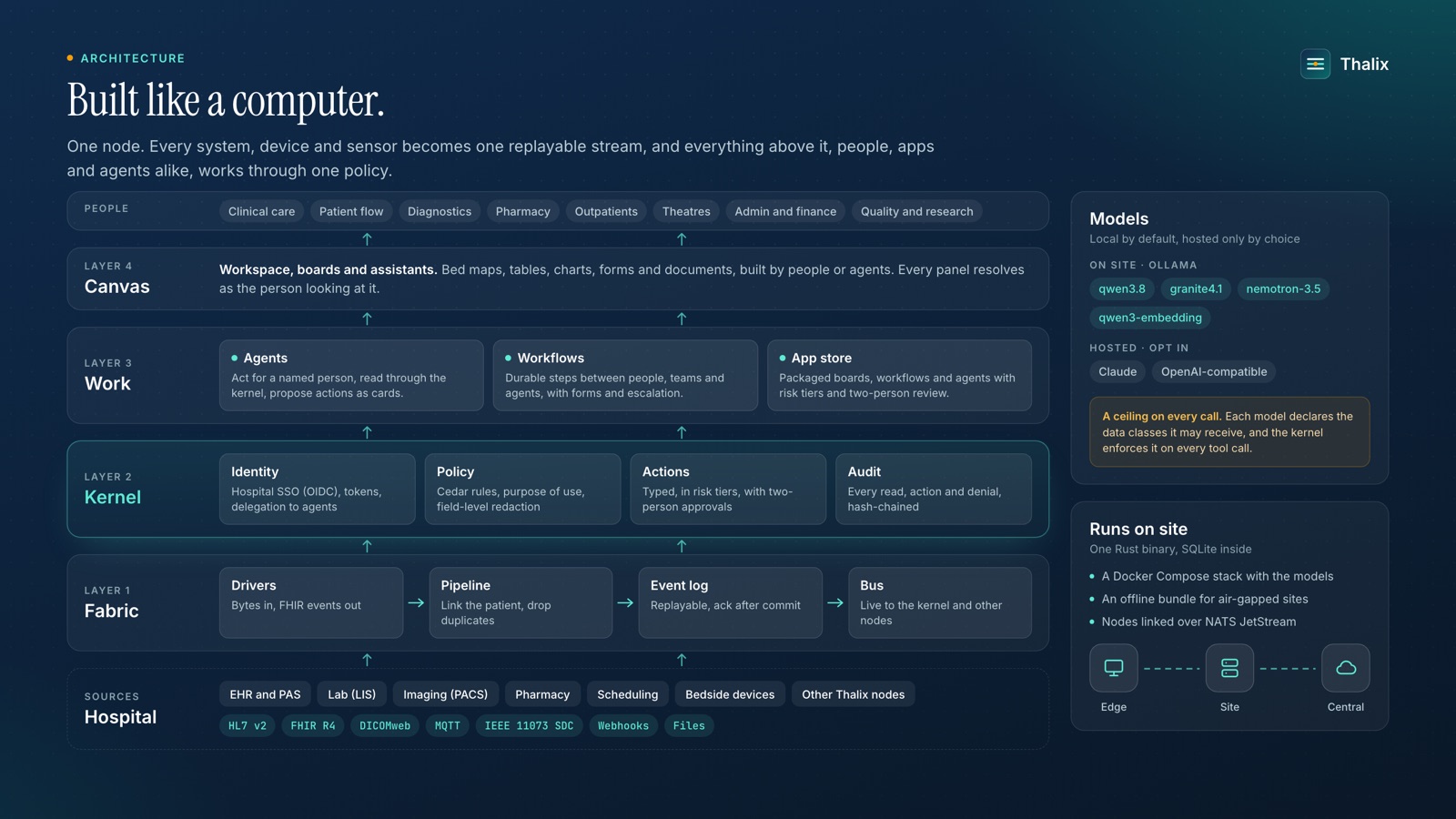
Thalix's hl7v2 driver maps A01, A04, A05/A14, A02, A03, A06/A07, the cancels A11, A12, A13, A27 and A38, A08, A28/A31 and the merge events A40 and A34–A36/A39 to FHIR R4 events. Any other ADT event isn't dropped: it becomes a message.unmapped event with a PHI-free summary, and the raw message is kept. Senders are acknowledged only after the event is durably logged, and a resend of a message already processed is acknowledged without being processed twice.
Thalix is at pilot stage. Demos run on synthetic data, and a hospital deployment needs its own clinical safety case, information governance approval and security review. We don't claim any certification or assessment result the product doesn't have.
 See Thalix workingA three-minute walkthrough on synthetic data: the console, agents, workflows and the audit trail →
Questions people ask
How many HL7 ADT message types are there?
HL7 table 0003 lists ADT trigger events from A01 to A62 (with A56 to A59 not in the table). Several, such as A18, A30, A34 to A36, A39, A46 and A48, are marked deprecated.
What is the difference between A08 and A31?
HL7 names A08 "update patient information", sent in the context of a visit, and A31 "update person information", for demographics without a visit. How your PAS uses each is local, so check its interface specification.
Which ADT event cancels a discharge?
A13, cancel discharge/end visit. A11 cancels an admit or visit notification and A12 cancels a transfer.
Sources
Each source below is an official page, read and checked in November 2026. Where a page and this guide differ, the official page wins.
- HL7 table 0003: event type HL7 Terminology · checked November 2026
- Comparison: HL7 v2 messaging (FHIR R5) HL7 · checked November 2026
General information only, written for hospital digital, IT, operations and clinical safety teams. It isn't legal, regulatory, information governance or clinical safety advice, and it doesn't replace your own organisation's processes or the official guidance linked above.