Interoperability
Integration engine vs API gateway: what's the difference in healthcare?
An API gateway sits in front of APIs and applies the same controls to every call: authentication, rate limiting and logging, as the UK government's API guidance describes it. An integration engine sits between systems and changes the messages themselves: it receives feeds such as HL7 v2, transforms them between formats and suppliers' variations, routes them, and queues and retries when a receiver is down. A hospital typically needs both: the gateway for APIs it exposes, the engine for the message flows between its systems.
What an API gateway does
GOV.UK's guidance on API management says a gateway acts as a proxy for APIs, so central services can be provided for every API that uses it. At minimum it handles user and application authentication, rate limiting and throttling of inbound requests, and logging and reporting. It is often sold with a developer portal (documentation, registration, self-service keys, a test environment), which the guidance treats as a separate thing. The guidance also warns that a gateway is another service to deploy and run.
The NHS does this nationally. A GOV.UK case study describes how NHS Digital used an API management platform as a proxy to apply one security pattern to all its APIs, centralised documentation on a developer hub, and rebuilt the Personal Demographics Service API as the exemplar.
What an integration engine does
- Receives HL7 v2 over MLLP, files, FHIR and webhooks, often from systems that can't call an API at all.
- Acknowledges, validates and stores messages.
- Transforms content: one supplier's ADT into another's expectations, or HL7 v2 into FHIR.
- Routes each message to the systems that should receive it.
- Queues, retries and holds messages it can't process, and can replay them.
Side by side
| API gateway | Integration engine | |
|---|---|---|
| Main job | Control access to APIs | Move and reshape data between systems |
| Traffic | Request and response (REST, FHIR) | Event messages, files, APIs |
| Changes content? | Usually not | Yes, mapping is the core of it |
| Typical controls | Authentication, rate limits, logging | Acknowledgement, validation, routing, retries, dead letters |
| Faces | Outside developers and apps | The hospital's own systems |
| Fails how | Calls refused or throttled | Messages delayed, misrouted or wrongly mapped |
The boundary blurs: many engines expose APIs, and some gateways can transform payloads. The question is which job you're buying for.
Choosing what you need
- If you're publishing APIs to apps and partners, you want gateway functions: consistent authentication, throttling, logs and documentation. DTAC's C4.1 asks suppliers whose products expose APIs to justify the standards they use and to document them openly.
- If your problem is feeds between systems, ADT to the bed board or results to the EPR, you need an engine, because the hard part is mapping and reliable delivery.
- NHS England's interoperability guidance makes the point that what matters is the standard an API conforms to, not the API itself. Neither product fixes data that doesn't follow FHIR UK Core, SNOMED CT or the NHS Number.
What it does not mean
- A gateway doesn't make data interoperable. It controls access; the content still has to follow shared standards.
- An engine isn't a security perimeter on its own. Its listeners and APIs still need authentication and encryption.
- You don't have to pick one. Many hospitals run an engine internally and a gateway at the edge.
Where Thalix fits
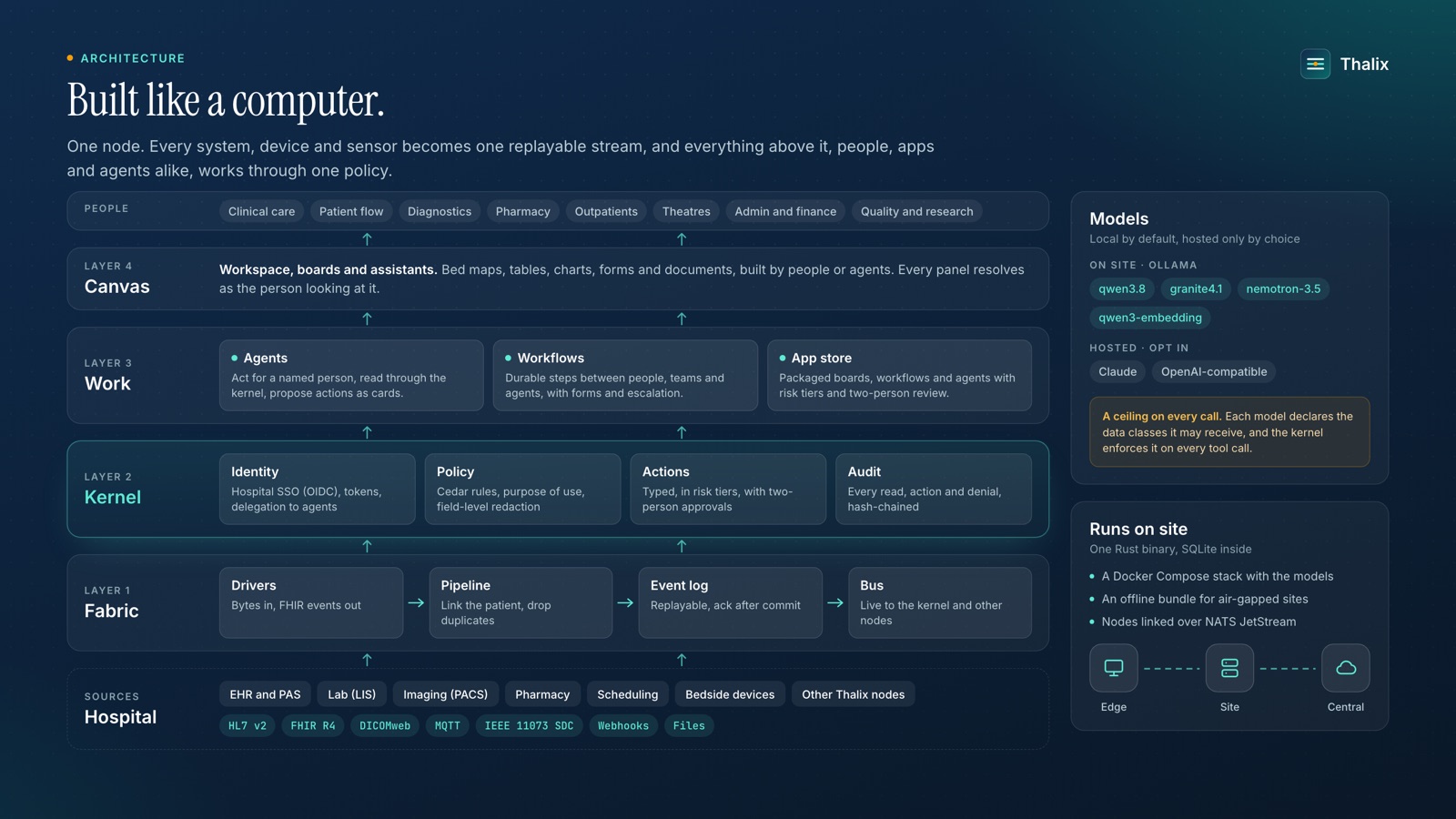
Thalix is on the integration side. Its node receives HL7 v2, FHIR, DICOMweb, MQTT, webhooks (with shared-secret, HMAC, basic or bearer authentication) and files into one ordered, replayable event log, acknowledging senders only after events are stored, keeping raw messages and holding anything unmappable as a dead letter to replay. It delivers onward over HTTP at least once. It also serves its own API and an MCP endpoint behind bearer tokens with roles and policy, but it isn't a general-purpose API gateway for a hospital's other APIs, and it can sit behind one.
Thalix is at pilot stage. Demos run on synthetic data, and a hospital deployment needs its own clinical safety case, information governance approval and security review. We don't claim any certification or assessment result the product doesn't have.
 See Thalix workingA three-minute walkthrough on synthetic data: the console, agents, workflows and the audit trail →
Questions people ask
Is an API gateway the same as an integration engine?
No. A gateway applies common controls (authentication, rate limiting, logging) to calls to APIs; an integration engine receives, transforms and routes messages between systems, including ones that don't use APIs.
Does an NHS hospital need an API gateway?
If it publishes APIs to apps or partners, gateway functions help apply consistent security and monitoring. GOV.UK's guidance suggests considering one early in an API programme, while noting it is another service to run.
Can an integration engine replace an API gateway?
Sometimes partly, since many engines expose APIs. But a gateway's job is consistent access control for many APIs, and an engine's is mapping and delivery, so most hospitals use both.
Sources
Each source below is an official page, read and checked in November 2026. Where a page and this guide differ, the official page wins.
- Defining an API management strategy Government Digital Service, GOV.UK · checked November 2026
- How NHS Digital used API management to support APIs at scale GOV.UK case study · checked November 2026
- Interoperability NHS England · checked November 2026
- DTAC form version 2.0, February 2026 (Word) NHS England Digital · checked November 2026
General information only, written for hospital digital, IT, operations and clinical safety teams. It isn't legal, regulatory, information governance or clinical safety advice, and it doesn't replace your own organisation's processes or the official guidance linked above.