Clinical safety and assurance
Clinical safety case report template: the structure under DCB0129
A clinical safety case report (CSCR) is the readable document that presents a manufacturer's argument and evidence that a health IT system is safe for a given use, in a given setting, at a point in its life. NHS England's DCB0129 implementation guidance suggests 11 sections, from the system definition and clinical risk management system through risk analysis, evaluation and control to the hazard log, test issues and the clinical safety officer's summary safety statement. The clinical safety officer approves every report.
The suggested structure
| Section | What it covers |
|---|---|
| 1 Introduction | The report's purpose and the lifecycle phase it relates to |
| 2 System definition | The system, its parts and version, the clinical environment, systems it replaces or interfaces with, numbers of users and patients |
| 3 Clinical risk management system | The manufacturer's process, key people and their roles, governance |
| 4 Clinical risk analysis | Hazards, patient safety consequences, causes, existing controls, risk estimates and who took part |
| 5 Clinical risk evaluation | Initial risk of each hazard against the pre-defined criteria |
| 6 Clinical risk control | Controls identified, justified, implemented and verified; residual risk |
| 7 Hazard log | The associated hazard log |
| 8 Test issues | Outstanding test issues and their effect on clinical safety |
| 9 Summary safety statement | The clinical safety officer's statement of the safety position for the intended deployment |
| 10 Quality assurance and approval | Evidence of review and approval |
| 11 Configuration control | Evidence that versions are controlled |
The guidance says this structure isn't prescriptive or definitive; the report should mirror how your own clinical safety case is organised.
What the reader must be able to find
Whatever the layout, DCB0129's guidance says the report needs to give the reader a summary of what is known about the system's clinical risks at that point, a clear record of the process used, a summary of the outcomes, a list of residual risks with the operational constraints that apply, a list of hazards and risks transferred to the deploying organisation with any controls it must put in place (training, for example), and outstanding test issues or defects that may affect safety. It should be readable, not a dump of the clinical risk management file.
When to issue one
DCB0129 requires a report at each lifecycle phase set in the clinical risk management plan. The guidance describes typical points: requirements (scope, hazards and initial risk), design (evaluation and controls chosen), test (evidence the controls work), delivery (completeness, residual risk, the exact release and anything transferred to the hospital) and modification (each later change). One report can be re-issued under configuration control, or separate reports issued. The manufacturer must make each report available to the receiving organisation, which uses it for its own DCB0160 work.
What DTAC assessors look for
DTAC question C1.2.4 asks for the report and hazard log for the product version being assessed. The form lists what it should include: the scope of the assessment, the approach to clinical risk management, a summary of the hazard assessment and mitigations, a test summary showing functional and non-functional testing, outstanding defects, and the hazards that need user or commissioner action. It also asks the manufacturer to state which risk scheme it used, and to summarise hazards it couldn't reduce as low as reasonably practicable.
What it does not mean
- One report doesn't cover every release. Each modification needs a report that names the release and the change.
- "Safe" is always conditional. The report holds for a stated use, environment and lifecycle point.
- Transferred risks aren't small print. They are the hospital's actions, and its DCB0160 safety case has to pick them up.
Where Thalix fits
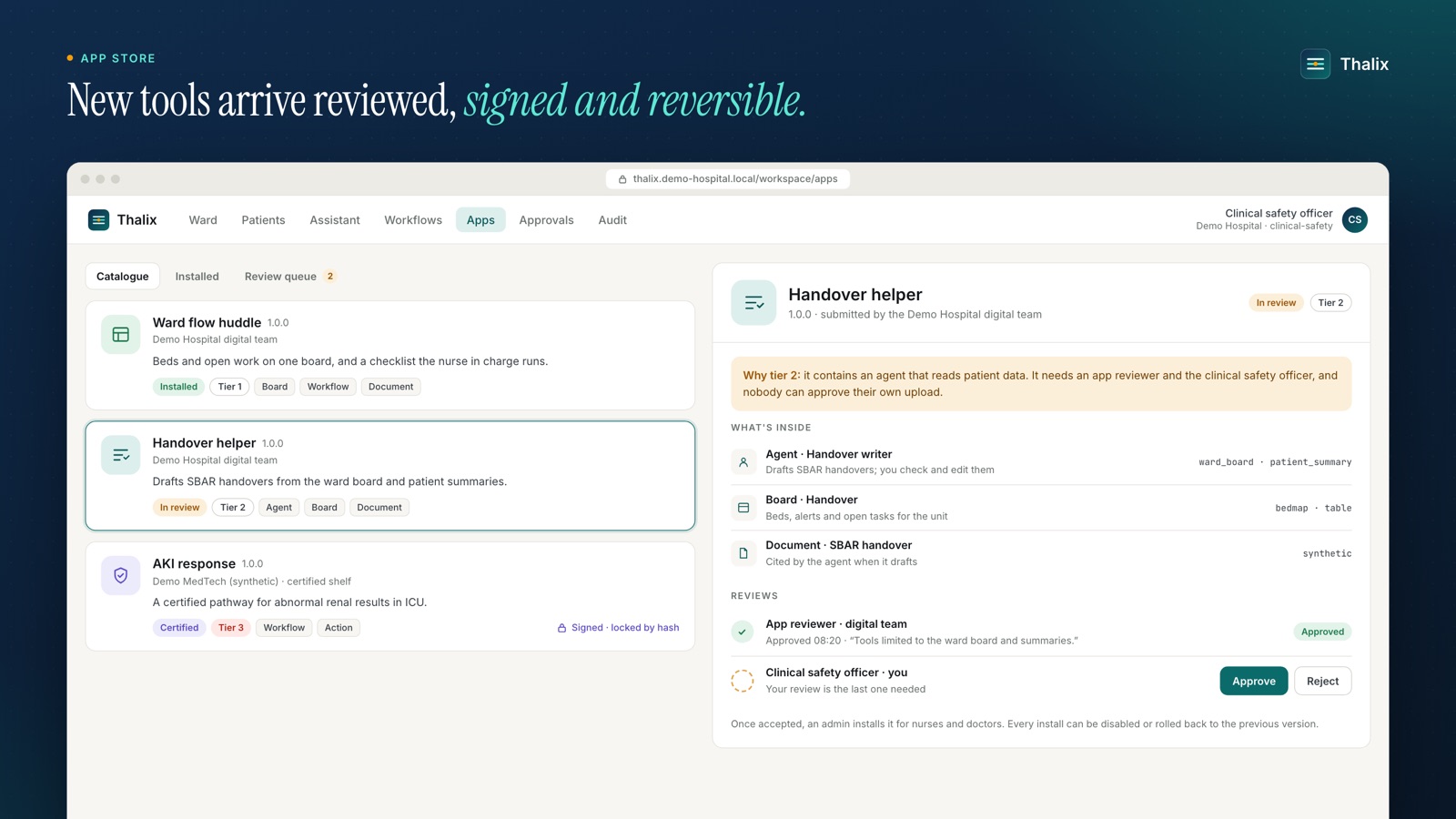
Thalix gives a manufacturer's safety case useful evidence for sections 6, 8 and 11: apps carry a risk tier worked out from their contents with the reason shown, nobody approves their own app, tier-2 apps need the clinical-safety role's recorded sign-off, tier-3 apps exist only as Ed25519-signed, locked packages whose content hash is checked at every install and restart, and a failed upgrade puts the previous version back. There is no Thalix clinical safety case report signed by a clinical safety officer today.
Thalix is at pilot stage. Demos run on synthetic data, and a hospital deployment needs its own clinical safety case, information governance approval and security review. We don't claim any certification or assessment result the product doesn't have.
 See Thalix workingA three-minute walkthrough on synthetic data: the console, agents, workflows and the audit trail →
Questions people ask
What sections go in a clinical safety case report?
NHS England's DCB0129 guidance suggests: introduction, system definition, clinical risk management system, risk analysis, risk evaluation, risk control, hazard log, test issues, summary safety statement, quality assurance and approval, and configuration control. It says the structure isn't prescriptive.
Who signs a clinical safety case report?
A clinical safety officer must approve each one under both DCB0129 and DCB0160.
Does DTAC ask for a clinical safety case report?
Yes. Question C1.2.4 asks for the clinical safety case report and hazard log, compliant with DCB0129, for the product version being assessed.
Sources
Each source below is an official page, read and checked in November 2026. Where a page and this guide differ, the official page wins.
- DCB0129 implementation guidance (Amd 24/2018, PDF) NHS England Digital · checked November 2026
- DCB0129: Clinical risk management in the manufacture of health IT systems NHS England Digital · checked November 2026
- DTAC form version 2.0, February 2026 (Word) NHS England Digital · checked November 2026
- Review of digital clinical safety standards DCB0129 and DCB0160 NHS England Digital · checked November 2026
General information only, written for hospital digital, IT, operations and clinical safety teams. It isn't legal, regulatory, information governance or clinical safety advice, and it doesn't replace your own organisation's processes or the official guidance linked above.