Clinical safety and assurance
DCB0160 template: the deploying organisation's safety case
Under DCB0160, the health organisation deploying a health IT system keeps its own clinical risk management file for that system: a clinical risk management plan with risk acceptability criteria, a hazard log, a clinical safety case report for each phase (deployment, use, maintenance and decommissioning), and a safety incident management log, all approved by its clinical safety officer. The supplier's DCB0129 safety case is a key input, not a substitute.
What goes in the clinical risk management file
The file is the repository for every record and document the process produces, set up at the start of the project and kept for the life of the system, including decommissioning. The DCB0160 guidance compares it to a filing cabinet: the cabinet is the file, the way it is organised is the safety case, and the safety case report is what you take out of it to show the safety position at a moment in time. It should hold:
- The clinical risk management plan, approved by the clinical safety officer.
- The hazard log, with each version approved.
- Clinical safety case reports, each approved.
- The safety incident management log.
- Records of hazard workshops, decisions that shaped the work, and the manufacturer's documents.
The clinical risk management plan
The guidance says the plan should describe the system and the clinical context it will be used in; the procedures, policies and resources for clinical risk management; the lifecycle phases and which activities apply in each; the criteria for estimating and accepting risk; who is responsible for each activity and who may approve safety documents; and when the plan is reviewed. It also points out an ordering trap: risk control analysis should finish before training material is finalised, because training may itself be one of the controls.
Safety case reports by phase
- Pre-deployment: built on the manufacturer's report, covering normal and abnormal operation and recovery, human factors and user error, the manufacturer's hazards and assumptions in your setting, and how the system interacts with your other systems.
- Post-deployment: revisited if assumptions about use or environment turn out wrong, or controls don't deliver the expected benefit.
- Maintenance: re-evaluated for any change to the system, its environment or its clinical use, including new or affected interfaces.
- Decommissioning: hazards of removing the system: retained capability, remaining interfaces, migration and preservation of records, backups.
The suggested report structure matches DCB0129's (introduction, system definition, risk management system, analysis, evaluation, control, hazard log, test issues, summary safety statement, approval and configuration control), written from the hospital's side.
Using the supplier's safety case
DCB0160 requirement 2.5.1 says that before deploying, the organisation must make sure the manufacturer and system comply with DCB0129. The manufacturer's report should list hazards and controls transferred to you, such as training or a business process change; each becomes an action in your hazard log with a local owner. Hazard analysis should be done by a multidisciplinary group: the clinical safety officer, clinical users from each affected area, and IT and facilities. If the group finds no hazards, the guidance says to record that judgement, who made it and when, and to repeat hazard identification whenever the scope changes.
The incident log
The safety incident management log records incidents with actual or potential clinical risk: reference, reporter, date, summary, clinical risk assessment, system configuration, a journal of work done, the date made safe, the date closed and the root cause. It can be per system or one central log.
What it does not mean
- Buying a DCB0129-compliant product doesn't complete DCB0160. The deploying organisation's own file, hazard log and reports are still required.
- Go-live isn't the end. The standard expects reports for use, maintenance and decommissioning too.
- The standards are under review. NHS England ran a consultation from 29 June to 11 September 2026; the 2018 versions apply until anything changes.
Where Thalix fits
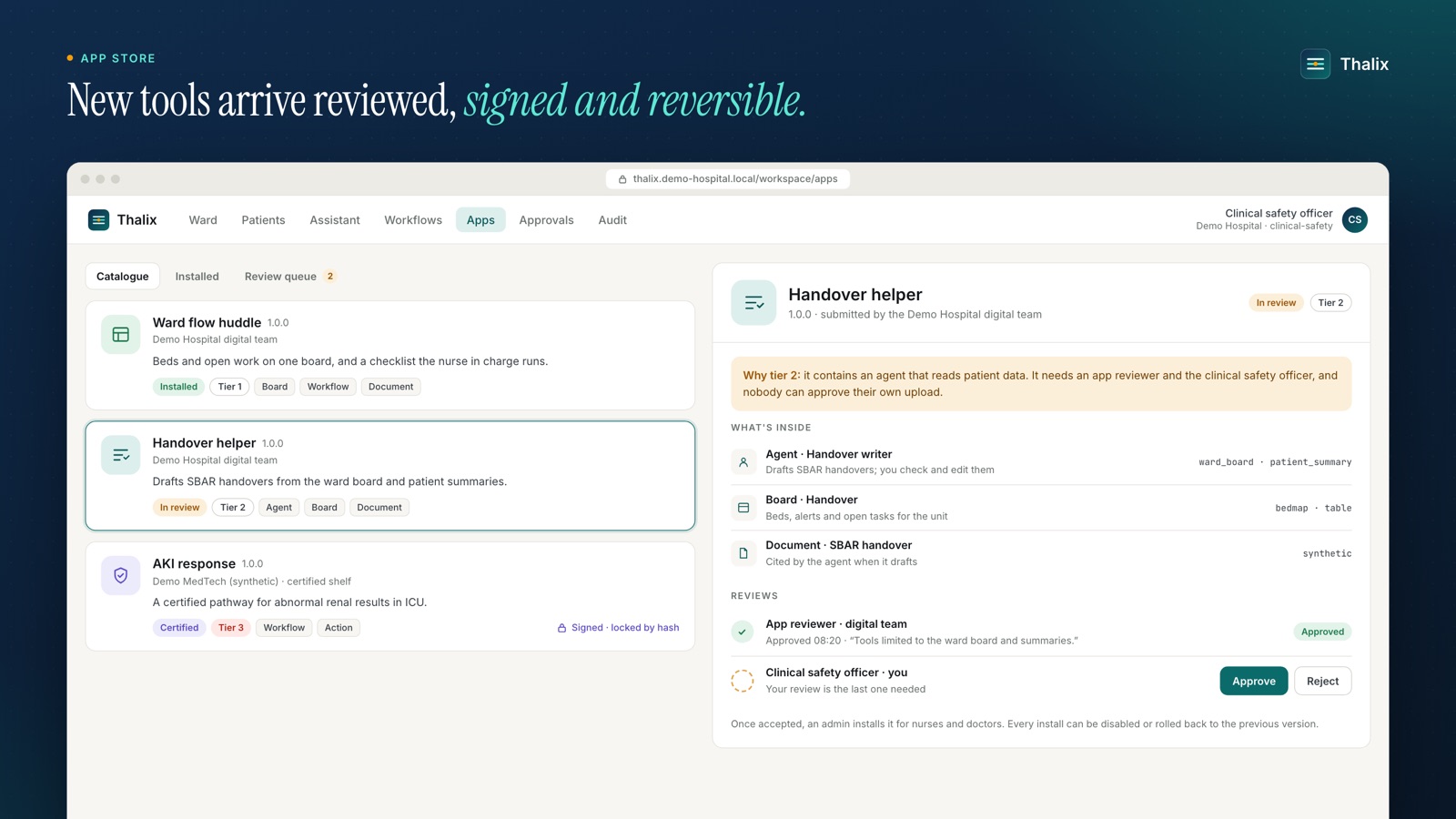
For a hospital's DCB0160 work, Thalix gives a maintenance-phase safety case something firm to point at. New agents, workflows and boards arrive as versioned apps with a risk tier and a stated reason; nobody approves their own app and tier 2 needs your clinical safety officer's recorded sign-off; tier 3 exists only as signed, locked packages; and a failed upgrade rolls back. Every read and action is in a hash-chained audit log, which helps when an incident needs reconstructing. A pilot with us runs with your clinical safety officer from day one; we haven't completed a DCB0160 safety case with any hospital.
Thalix is at pilot stage. Demos run on synthetic data, and a hospital deployment needs its own clinical safety case, information governance approval and security review. We don't claim any certification or assessment result the product doesn't have.
 See Thalix workingA three-minute walkthrough on synthetic data: the console, agents, workflows and the audit trail →
Questions people ask
What documents does DCB0160 require?
A clinical risk management file holding a clinical risk management plan, a hazard log, clinical safety case reports for each lifecycle phase, and a safety incident management log, with the plan, every hazard log version and every report approved by a clinical safety officer.
Can a hospital rely on the supplier's DCB0129 safety case?
It's a key input, and DCB0160 requires the hospital to confirm the supplier complies with DCB0129. But the hospital still produces its own hazard log and safety case reports for its setting.
Are DCB0129 and DCB0160 being changed?
NHS England is reviewing them. A public consultation ran from 29 June to 11 September 2026; no revised standards have been published yet.
Sources
Each source below is an official page, read and checked in November 2026. Where a page and this guide differ, the official page wins.
- DCB0160 implementation guidance (Amd 25/2018, PDF) NHS England Digital · checked November 2026
- DCB0160: Clinical risk management in the deployment and use of health IT systems NHS England Digital · checked November 2026
- DTAC form version 2.0, February 2026 (Word) NHS England Digital · checked November 2026
- Review of digital clinical safety standards DCB0129 and DCB0160 NHS England Digital · checked November 2026
General information only, written for hospital digital, IT, operations and clinical safety teams. It isn't legal, regulatory, information governance or clinical safety advice, and it doesn't replace your own organisation's processes or the official guidance linked above.