Clinical safety and assurance
LFPSE explained: what "LFPSE-compliant" software means
Learn from Patient Safety Events (LFPSE) is NHS England's national system for recording and analysing patient safety events. It replaced the National Reporting and Learning System (NRLS), which was decommissioned on 30 June 2024. Organisations with a local risk management system (LRMS) record events through an LFPSE-compliant version of it; "LFPSE-compliant" means that product and version has passed NHS England's LFPSE compliance testing and appears on its supplier list.
Two ways events reach LFPSE
- Through a local risk management system. Most trusts record incidents in an LRMS, which shares the events with LFPSE. The LRMS has to be on a compliant version.
- Directly online. Organisations without an LRMS, typically GP, dental and optometry practices and community pharmacies, are asked to record events directly in the LFPSE online service.
The FAQ says any healthcare provider with an ODS code can record events. Recording individual events is voluntary, except where it meets other statutory duties such as notifying the CQC; the NHS Standard Contract (SC33.2) requires providers to be able to report patient safety incidents to the NRLS "or any system which replaces it".
What LFPSE compliance means for software
NHS England publishes a list of LRMS products that have passed LFPSE compliance testing. In November 2026 the list shows compliance against LFPSE versions 5.0 and 6.0, with version 4.0 deprecated, and it notes you can only start recording to LFPSE on the latest live version. For each product it shows whether it is available for live use and the local implementation cost, and some entries carry scope notes, such as incident recording only, or local versus central hosting.
Behind that, the FAQ explains that only fields from the LFPSE taxonomy are uploaded. Providers can configure extra local fields, as long as each record meets the core mandatory LFPSE dataset. Vendors told NHS England there would be no direct cost to upgrade to compliant versions, though some support contracts may mean local spend.
What to check before you buy or upgrade
- The exact product and version you'll run is on NHS England's list and marked available for live use.
- Any scope notes match what you need to record.
- Who pays for and does the upgrade, especially for a locally hosted system.
- How the supplier will follow later LFPSE versions; NHS England says vendors have different timelines.
- Procurement follows the usual rules: NHS England's list isn't an endorsement that replaces your own process.
StEIS, PSIRF and personal data
The Strategic Executive Information System (StEIS) is still in use while the next version of LFPSE is rolled out to replace it; the FAQ says it will be decommissioned once all providers have transitioned to PSIRF via LFPSE. LFPSE and the Patient Safety Incident Response Framework both sit in the NHS Patient Safety Strategy, and PSIRF response fields are now in the LFPSE portal. NHS England asks users to avoid submitting personal data in records, and redacts identifiable details from free text where it is submitted. NHS England describes the service as in public beta.
What it does not mean
- "LFPSE-compliant" isn't a general quality mark. It means a named product version passed LFPSE compliance testing.
- A compliant product isn't compliant forever. Compliance is listed per LFPSE version, and older versions are deprecated.
- LFPSE isn't the hospital's own incident system. The LRMS still holds local workflow; LFPSE receives the national dataset.
Where Thalix fits
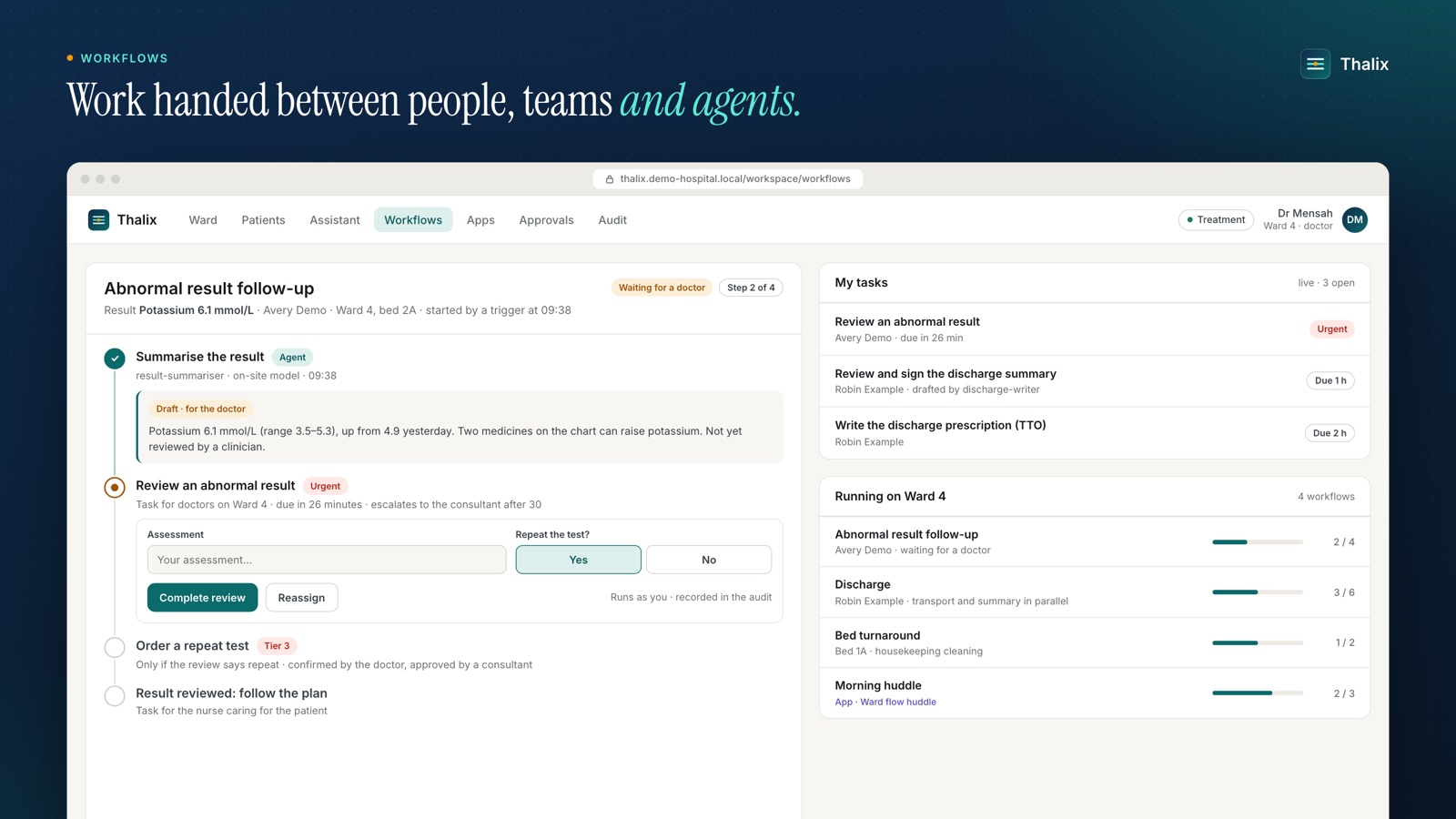
Thalix isn't an incident management system and isn't on NHS England's LFPSE supplier list. Where it can help is upstream: the home page lists summarising and routing incident reports among the work agents can prepare for a person to check, and workflows can create tasks with owners, due times and escalation. Anything recorded to LFPSE would still go through your compliant LRMS or the online service.
Thalix is at pilot stage. Demos run on synthetic data, and a hospital deployment needs its own clinical safety case, information governance approval and security review. We don't claim any certification or assessment result the product doesn't have.
 See Thalix workingA three-minute walkthrough on synthetic data: the console, agents, workflows and the audit trail →
Questions people ask
What replaced the NRLS?
LFPSE. NHS England says organisations moved to LFPSE rather than the National Reporting and Learning System, which was decommissioned on 30 June 2024.
How do I know if a risk management system is LFPSE-compliant?
Check NHS England's LRMS supplier list for the product and version, its LFPSE version compliance (5.0 and 6.0 in November 2026) and whether it is available for live use.
Has LFPSE replaced StEIS?
Not yet. NHS England says StEIS is still in use while the next version of LFPSE is rolled out to replace it.
Sources
Each source below is an official page, read and checked in November 2026. Where a page and this guide differ, the official page wins.
- Learn from patient safety events (LFPSE) service NHS England · checked November 2026
- LFPSE: local risk management system suppliers NHS England · checked November 2026
- LFPSE frequently asked questions NHS England · checked November 2026
General information only, written for hospital digital, IT, operations and clinical safety teams. It isn't legal, regulatory, information governance or clinical safety advice, and it doesn't replace your own organisation's processes or the official guidance linked above.