Clinical safety and assurance
DTAC requirements, section by section (form v2.0, 2026)
The DTAC form (version 2.0, updated 24 February 2026) has two context sections that aren't assessed (A, company information; B, value proposition), four assessed sections that products must meet to pass (C1 clinical safety, C2 data protection, C3 technical security, C4 interoperability) and a scored but not pass-or-fail section (D1 usability and accessibility). Manufacturers must use it instead of v1.0 from 6 April 2026.
Is your product in scope?
DTAC covers software, including web and mobile apps and software as a service, designed or marketed to improve health outcomes or how the health and care system works. The form's examples include software that influences the care someone receives, such as appointment scheduling or digital referrals, and software that releases staff time or improves efficiency, such as bed management. It isn't for firmware or software embedded in devices such as CT scanners, or for general software not marketed for health or care, like payroll.
Sections A and B: context
A asks for company and product details, including the product version the form covers and, if registered, the latest CQC assessment. B asks for the intended use, a description of what the product does, the users and benefits (and how they were validated), and the data flows between the product and other health IT, ideally with a user journey map.
C1: clinical safety
- C1.1 Is it software or AI as a medical device? If so, provide the medical device pre-acquisition questionnaire (PAQ).
- C1.2 Does it provide information that can influence, support or manage near real-time direct care? If not, justify why DCB0129 doesn't apply; buyers can challenge that.
- C1.2.2–C1.2.4 Confirm DCB0129 clinical risk management, describe the clinical risk management system, and supply the clinical safety case report and hazard log. The report should state the risk scheme used, because no single scheme is mandated across the NHS.
- C1.2.5 Name the clinical safety officer, with profession and registration. The CSO can be outsourced; the old requirement for NHS England DTAC training no longer applies.
C2 and C3: data protection and security
C2 asks for a DSPT status of Standards Met or Exceeded where the supplier has access to patient data or NHS systems, ICO registration, a product DPIA, transparency information, fair terms on data, and where data is stored. C3 asks for a valid Cyber Essentials certificate, whether the supplier has signed the Cyber Security Charter for Suppliers to the NHS (which skips the rest of C3), an external OWASP Top 10 penetration test from the last 12 months with nothing at CVSS 7.0 or above, adherence to the Software Security Code of Practice, an MFA plan with MFA on privileged supplier accounts, and defined logging.
C4: interoperability
- C4.1 If the product exposes APIs, list and justify the standards they use, and confirm they follow GDS open API best practice and are openly documented and freely available to third parties, or explain how they're made available.
- C4.2 If it exchanges data with clinical or administrative systems where patient identity matters: can it use the NHS Number, and does it check the number against PDS or a local record system? If not, explain how correct identification and data quality are assured.
- C4.2.4–C4.2.6 If patients use it directly, NHS login or another robust approach to identity verification; public health and adult social care use must support DAPB3051.
D1: usability and accessibility
Not pass or fail, but compared between products: how the product fits care pathways, testing with intended users, the Accessible Information Standard, WCAG 2.2 AA for web and mobile apps (or a plan and timescale), a published accessibility statement, and average availability over the last 12 months to two decimal places.
What it does not mean
- Section D isn't optional to answer. It doesn't decide a pass, but buyers use it to compare products.
- "Not a device" isn't the end of C1. Products that influence direct care still need DCB0129 work.
- APIs don't have to be FHIR to pass C4.1, but the standards used have to be listed and justified for the use case.
Where Thalix fits
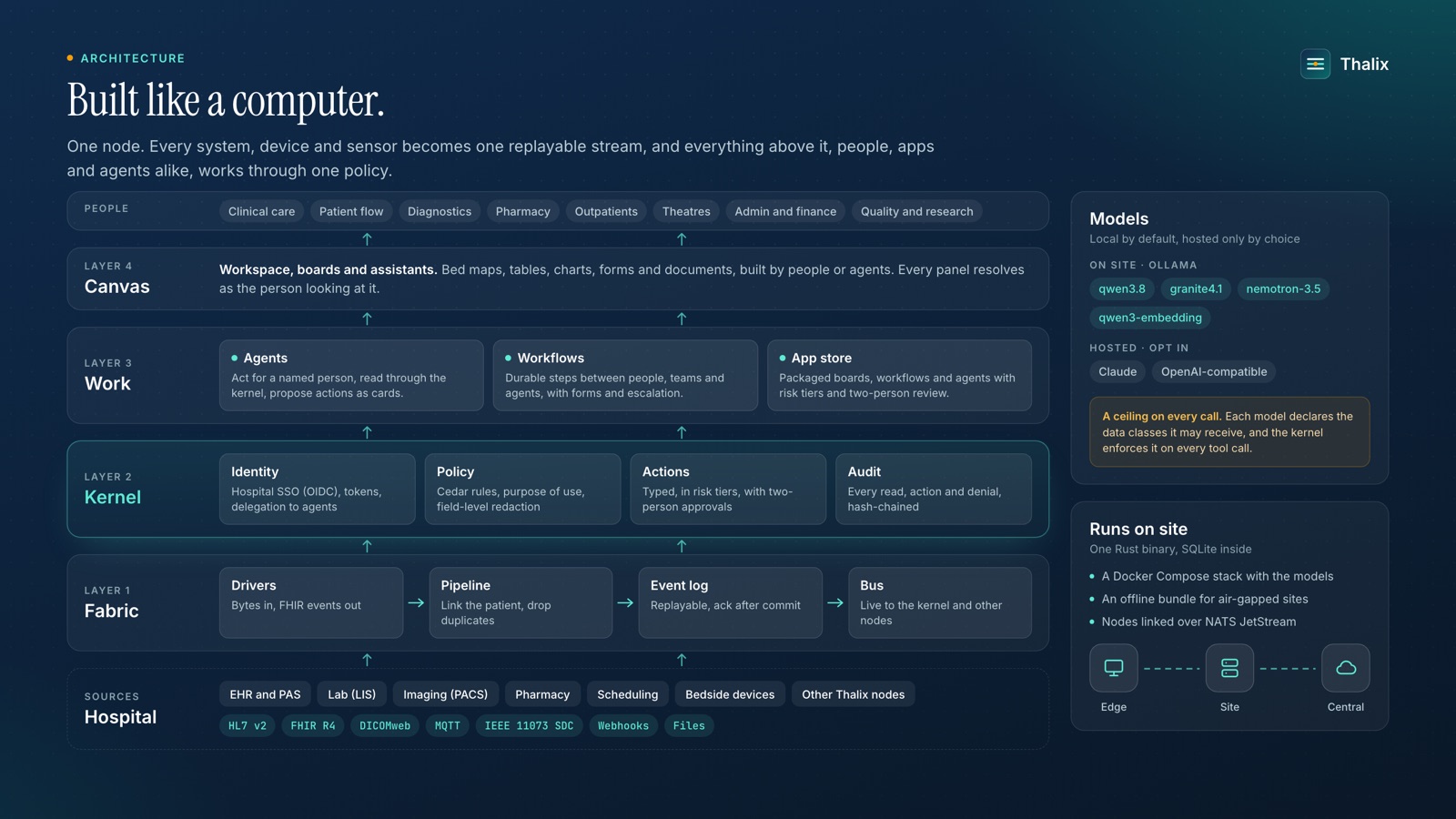
We'd answer the form for a specific Thalix version, and some answers are already concrete in the code. For C4, Thalix speaks HL7 v2 over MLLP, FHIR R4 (polling, subscriptions, SMART Backend Services) and DICOMweb, and documents its own HTTP API and MCP endpoint. For C4.2, every identifier a source sends, including the NHS Number, links to one Thalix patient, and conflicts go to a person instead of being merged. For C1, agents never make clinical decisions and changes are reviewed by your clinical safety officer. There is no completed DTAC form, safety case or certificate to share today.
Thalix is at pilot stage. Demos run on synthetic data, and a hospital deployment needs its own clinical safety case, information governance approval and security review. We don't claim any certification or assessment result the product doesn't have.
 See Thalix workingA three-minute walkthrough on synthetic data: the console, agents, workflows and the audit trail →
Questions people ask
What are the five DTAC sections?
Clinical safety (C1), data protection (C2), technical security (C3), interoperability (C4), and usability and accessibility (D1). Sections A and B give context and aren't assessed.
Which DTAC sections are pass or fail?
The form says products must meet sections C1 to C4 to pass. Section D1 is scored to inform buyers but isn't pass or fail.
Is bed management software in scope of DTAC?
Yes. The v2.0 form lists software designed to release staff time or improve efficiency, such as bed management, as in scope.
Sources
Each source below is an official page, read and checked in November 2026. Where a page and this guide differ, the official page wins.
- DTAC form version 2.0, February 2026 (Word) NHS England Digital · checked November 2026
- Digital Technology Assessment Criteria (DTAC) guidance for buyers and suppliers NHS England Digital · checked November 2026
- How DTAC works NHS England Digital · checked November 2026
- Conduct a DTAC assessment NHS England Digital · checked November 2026
General information only, written for hospital digital, IT, operations and clinical safety teams. It isn't legal, regulatory, information governance or clinical safety advice, and it doesn't replace your own organisation's processes or the official guidance linked above.