Clinical safety and assurance
DTAC security: the data protection and technical security sections
DTAC's security questions sit in two assessed sections of the February 2026 form. C2 (data protection) asks for a DSPT status of Standards Met or Exceeded if the supplier has access to patient data or NHS systems, ICO registration, a DPIA, transparency information and where data is stored. C3 (technical security) asks for a valid Cyber Essentials certificate, an external penetration test from the last 12 months covering the OWASP Top 10 with nothing scoring 7.0 or above on CVSS, adherence to the Software Security Code of Practice, an MFA plan and defined logging.
C2: data protection
| Question | What passes |
|---|---|
| C2.1 DSPT | If the supplier has direct or remote access to patient data or NHS systems: Standards Met or Exceeded for the current year (or the previous year if this year's isn't due yet), checked by the assessor against the DSPT database. |
| C2.2 Personal data | If the product processes no personal data, and the supplier has no means of accessing it (including remote support), the rest of C2 can be skipped. |
| C2.2.1 ICO | Evidence of current registration, checked against the ICO's register of fee payers. |
| C2.2.2 DPIA | A product DPIA covering data fields, flows, user access controls, technical and organisational measures in transit and at rest, countries, supplier staff access, controllers, retention, processors and data subject rights. |
| C2.2.3 Transparency | Materials the buyer can use for its own UK GDPR transparency duties. |
| C2.2.4 Terms | Clear and fair terms on privacy and use of data. |
| C2.2.5–6 Location | Where data is stored and processed; outside the UK needs adequacy or a safeguard such as an IDTA with a transfer risk assessment. |
C3: technical security
- C3.1 Cyber Essentials. A valid certificate (they last 12 months), checked against the IASME database. Its scope should cover all systems and services under the supplier's control that support developing, running and managing the product.
- C3.2 Cyber Security Charter. A supplier that has signed the Cyber Security Charter for Suppliers to the NHS can skip the rest of C3.
- C3.3 Penetration test. For an internet-based product or one accessible from the internet, the summary report of an external penetration test by a third party, within the previous 12 months, that included the OWASP Top 10. The report must show no vulnerabilities scoring 7.0 or above on CVSS.
- C3.4 Secure development. Confirmation that the software follows the DSIT and NCSC Software Security Code of Practice: secure design and development, a secure build environment, secure deployment and maintenance, and communication with customers.
- C3.5 MFA. A plan for multi-factor authentication on all account types, preferably through identity federation, and MFA on every supplier account with privileged access to the product (it can be applied at the network edge rather than in the product).
- C3.6 Logging. Logging and reporting requirements defined, with audit trails of access in place.
How it fits with the DSPT
NHS England cut DTAC's questions by about a quarter in 2026, partly by removing what the DSPT already covers, so the two now work together: C2.1 relies on the supplier's DSPT status, and the DSPT's own supplier assertions cover areas such as penetration testing (assertion 9.2), firewalls and supplier due diligence. A supplier that holds no NHS data and has no access to NHS systems, for example software installed and run entirely on the hospital's own infrastructure with no remote support access, can answer C2.1 accordingly.
Preparing the evidence
- Book the penetration test early and re-test after fixes, so the summary you share has nothing at 7.0 or above.
- Write the DPIA for the product, not the company, and expect the buyer to build its own DPIA as controller from yours.
- Check the Cyber Essentials scope matches the product's real environment, including build and support systems.
- Be ready to show the logs, not just say they exist: who accessed what, when, and with which account.
What it does not mean
- Cyber Essentials alone isn't enough. C3 also asks for a penetration test, secure development, MFA and logging, unless the supplier has signed the Charter.
- "On-premises" doesn't remove data protection. If the supplier can reach the data for support, C2 still applies.
- A clean pen test isn't permanent. The form asks for one from the previous 12 months.
Where Thalix fits
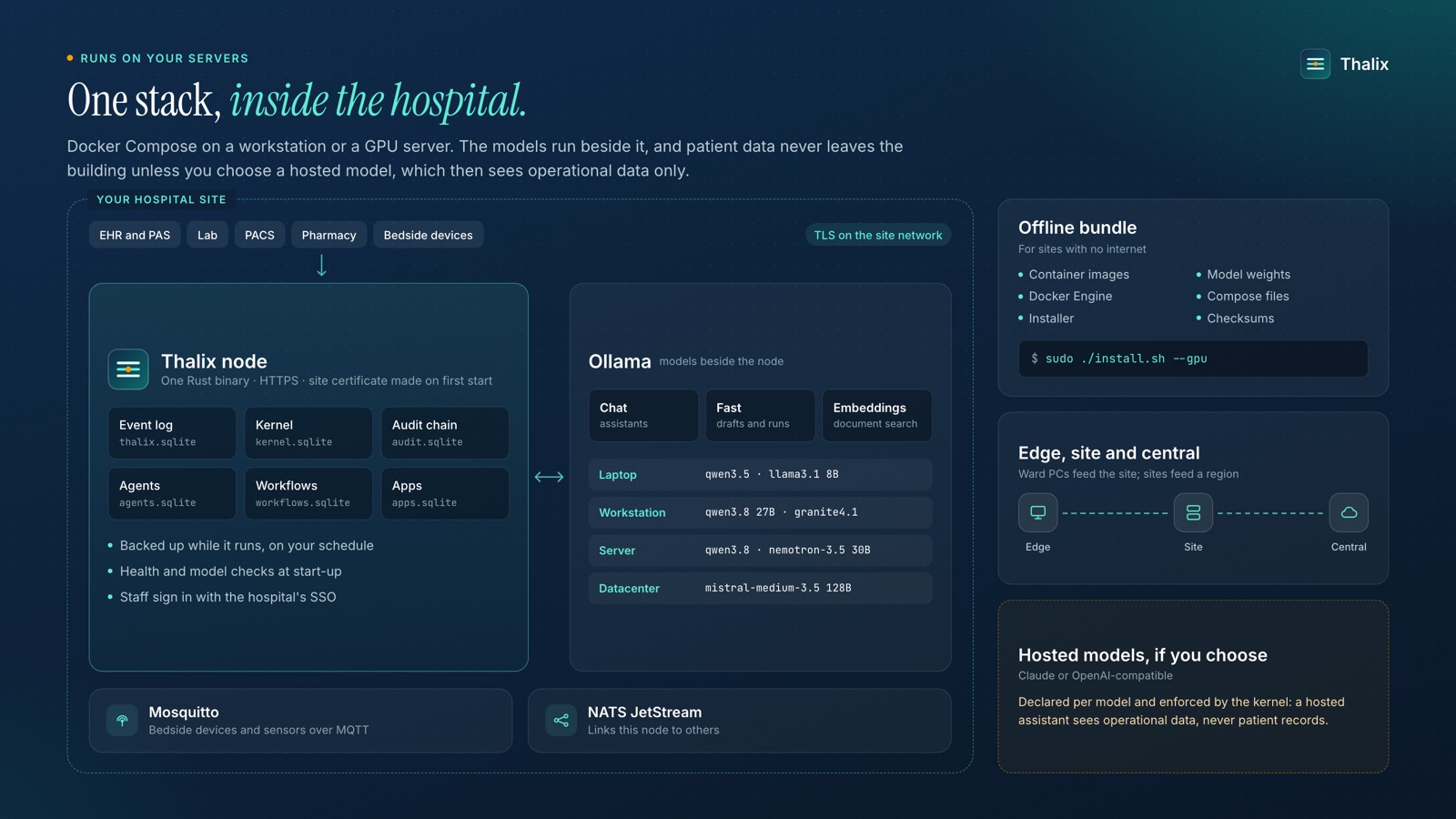
Thalix has no Cyber Essentials certificate, penetration test report or DSPT status to show today, and we won't imply otherwise; a pilot would include them. What the code already does for C3: network listeners refuse to start without TLS (1.2/1.3, optionally mutual TLS), bearer tokens are compared in constant time and only their SHA-256 digests are held in memory, secrets are references (env: or file:) and plain text is refused, key files that are world-readable are refused, PHI stays out of logs and errors, and every read and action is audited in a verifiable hash chain (C3.6). Because it runs on the hospital's servers, patient data doesn't leave the building unless the hospital sends it.
Thalix is at pilot stage. Demos run on synthetic data, and a hospital deployment needs its own clinical safety case, information governance approval and security review. We don't claim any certification or assessment result the product doesn't have.
 See Thalix workingA three-minute walkthrough on synthetic data: the console, agents, workflows and the audit trail →
Questions people ask
Does DTAC require a penetration test?
For internet-based products, or products accessible from the internet, C3.3 asks for the summary of an external third-party penetration test from the previous 12 months that included the OWASP Top 10, showing no vulnerabilities scoring 7.0 or above on CVSS.
Is Cyber Essentials required for DTAC?
Yes. C3.1 asks for a valid Cyber Essentials certificate, which the assessor checks against the IASME database. Certificates last 12 months.
Do suppliers need the DSPT for DTAC?
If the supplier has direct or remote access to patient data or NHS systems, C2.1 asks it to confirm Standards Met or Exceeded on the DSPT, which the assessor checks against the DSPT database.
Sources
Each source below is an official page, read and checked in November 2026. Where a page and this guide differ, the official page wins.
- DTAC form version 2.0, February 2026 (Word) NHS England Digital · checked November 2026
- Digital Technology Assessment Criteria (DTAC) guidance for buyers and suppliers NHS England Digital · checked November 2026
- DTAC in relation to other regulatory and assurance processes NHS England Digital · checked November 2026
- DSPT 2026-27 assertions and evidence items, categories 2 to 4 (v1.1, spreadsheet) NHS England, DSPT · checked November 2026
General information only, written for hospital digital, IT, operations and clinical safety teams. It isn't legal, regulatory, information governance or clinical safety advice, and it doesn't replace your own organisation's processes or the official guidance linked above.