Clinical safety and assurance
Is DTAC a certification? What "DTAC certified" really means
No. The Digital Technology Assessment Criteria (DTAC) is an assessment, not a certificate. The manufacturer completes NHS England's DTAC form for each product version, and each NHS or social care organisation that buys or deploys the product assesses it. NHS England says it doesn't currently endorse any third-party certification schemes for DTAC, though it is exploring a certification scheme of its own.
How DTAC actually works
NHS England describes DTAC as an assessment framework for care commissioners and providers to use when assuring digital health technology. The current form, version 2.0, was last updated on 24 February 2026; manufacturers must provide it instead of the older v1.0 form from 6 April 2026 when an organisation asks. The roles are:
- The manufacturer completes the form for each product version, keeps it up to date with its supporting documents and provides it on request. A reseller has to work with the manufacturer to provide it. Incomplete forms, or forms with sections deleted, shouldn't be submitted.
- The buyer (a care provider or commissioner) assesses the form as part of due diligence before purchasing and deploying, including for trials and products offered outside normal procurement, and keeps a record of the product, version and result.
Buyers are asked to accept NHS England's standard form and not to create their own versions of it, sending any extra requirements as separate requests.
What "passing" means
The form says sections C1 to C4 (clinical safety, data protection, technical security and interoperability) are the core criteria, and products must meet them to pass assessment. Section D (usability and accessibility) is scored to inform buyers but isn't pass or fail. Each question in section C carries its own "to pass" criterion, such as a valid Cyber Essentials certificate or a DCB0129-compliant safety case report and hazard log.
So a pass is a judgement made by a particular organisation, about a particular version of a product, at a particular time. Another organisation may assess the same form and reach its own view, and NHS England asks buyers to re-assess elements that expire or change with upgrades.
Claims a supplier can fairly make
| Fair | Misleading |
|---|---|
| "We have a completed DTAC form (v2.0) for version 3.4, available on request." | "DTAC certified" or "DTAC accredited" |
| "Assessed against DTAC by [named trust] in 2026 for version 3.4." | "NHS approved" on the strength of one organisation's assessment |
| "We hold Cyber Essentials and our CSO is registered with [body]." | "DTAC compliant" with no form, version or date behind it |
If a consultant or platform offers a "DTAC certificate", it is their own scheme: NHS England doesn't endorse third-party DTAC certification. A consultant can help a manufacturer prepare honest answers and the documents behind them (the DCB0129 safety case, DPIA, penetration test summary), but the assessment still belongs to the buyer.
What DTAC sits alongside
DTAC doesn't replace other approvals. Medical device products still need the right regulatory status (the form asks for the medical device pre-acquisition questionnaire where software qualifies as a device), organisations processing personal data need ICO registration, and suppliers with access to NHS patient data or systems need a current DSPT status of Standards Met or Exceeded. The deploying organisation keeps its own DCB0160 duty, which a supplier's DTAC form informs but doesn't discharge.
What it does not mean
- A completed form isn't approval. It's the manufacturer's evidence; the buyer decides.
- One trust's assessment doesn't bind another. Each organisation that buys or deploys keeps its own duty to assess.
- Passing DTAC doesn't make a product the right choice. NHS England says buyers must still judge value for money and fit for their own context.
Where Thalix fits
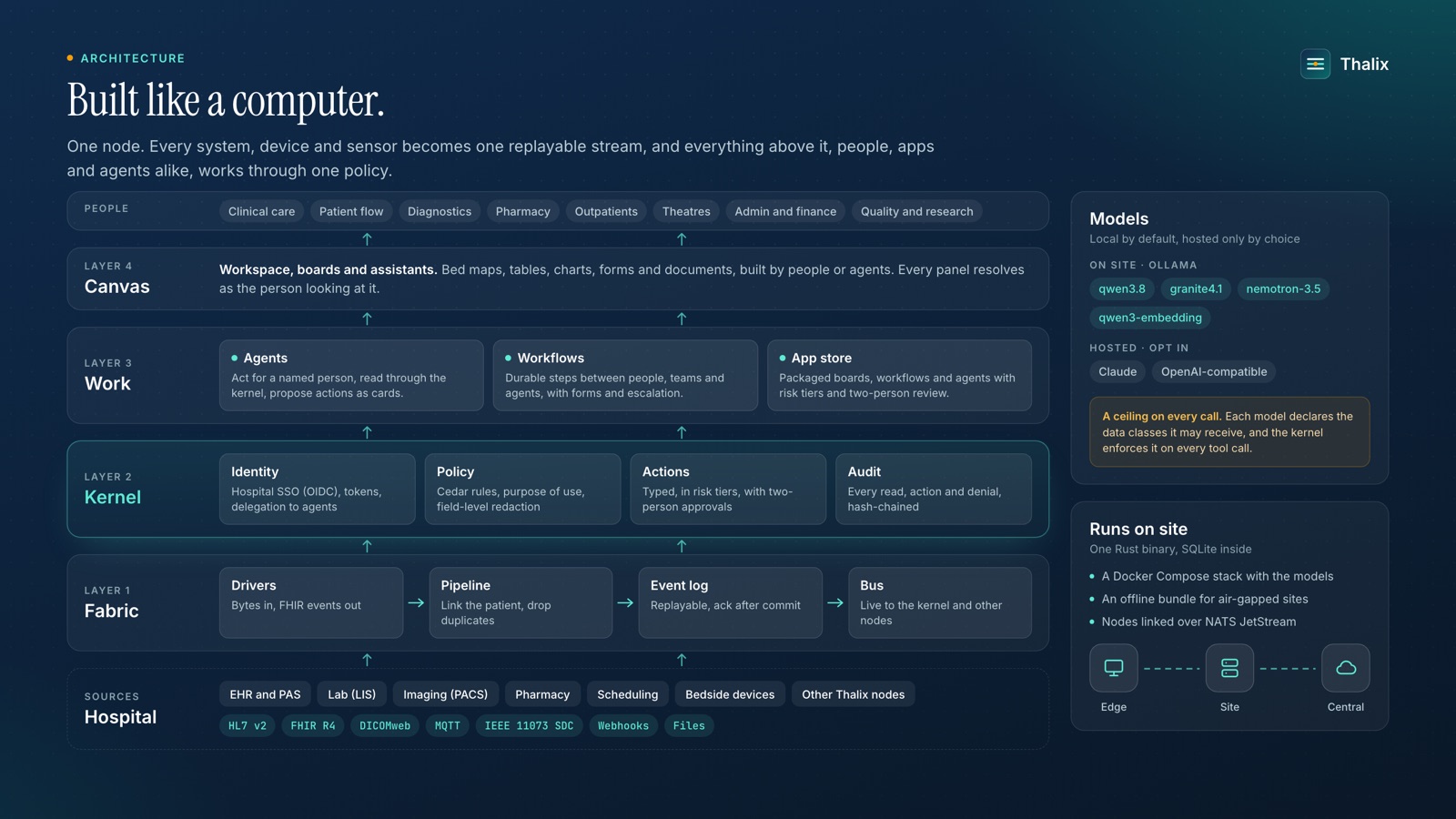
Thalix doesn't have a completed DTAC assessment, and we don't describe it as DTAC compliant, certified or approved. If a hospital wants to pilot it, we'd complete the v2.0 form for the version being piloted and give your teams the evidence behind each answer, with gaps stated plainly. Some answers are already shaped by the code: FHIR R4 and HL7 v2 interfaces (C4), patient identifiers linked deliberately with conflicts sent to a person (C4.2), and an audit trail of every access (C3.6).
Thalix is at pilot stage. Demos run on synthetic data, and a hospital deployment needs its own clinical safety case, information governance approval and security review. We don't claim any certification or assessment result the product doesn't have.
 See Thalix workingA three-minute walkthrough on synthetic data: the console, agents, workflows and the audit trail →
Questions people ask
Is there an official DTAC certificate?
No. NHS England says it doesn't currently endorse any third-party certification schemes for DTAC, and that it is exploring a certification scheme for digital health technologies.
Who assesses DTAC?
The care commissioner or provider buying or deploying the product, using the manufacturer's completed DTAC form. NHS England's guidance names an accountable officer and subject matter expert for each section, such as the clinical safety officer for C1.
Does a DTAC assessment expire?
The form is for a specific product version, and NHS England asks buyers to re-assess elements that have an expiry date or change with upgrades. Some evidence, such as a Cyber Essentials certificate, is only valid for 12 months.
Sources
Each source below is an official page, read and checked in November 2026. Where a page and this guide differ, the official page wins.
- Digital Technology Assessment Criteria (DTAC) guidance for buyers and suppliers NHS England Digital · checked November 2026
- How DTAC works NHS England Digital · checked November 2026
- Conduct a DTAC assessment NHS England Digital · checked November 2026
- DTAC form version 2.0, February 2026 (Word) NHS England Digital · checked November 2026
- DTAC in relation to other regulatory and assurance processes NHS England Digital · checked November 2026
General information only, written for hospital digital, IT, operations and clinical safety teams. It isn't legal, regulatory, information governance or clinical safety advice, and it doesn't replace your own organisation's processes or the official guidance linked above.