AI and hospital operations
Hospital back-office automation: what gets automated, and how
Hospital back-office automation means using software to do the repetitive administrative work around care: keying data between systems, processing invoices and HR forms, preparing referrals, bookings and letters, and supporting clinical coding. NHS organisations do it with three main tools: robotic process automation (software robots that use screens like a person), integration through APIs and message feeds, and AI that reads or drafts text. NHS England's own guidance on software robots says to use APIs first.
What NHS organisations automate
NHS Shared Business Services, a joint venture between DHSC and Sopra Steria, lists the processes it automates for NHS organisations. A sample:
- Finance: invoice processing and matching, credit notes, reconciliations, journal uploads, payment reminders.
- HR and workforce: keying data into ESR, offer letters, interview invitations, starter and leaver processes, medical rota notifications.
- Procurement: purchase orders, supplier onboarding, contract expiry notices, catalogue checks, inventory.
- Clinical and operational admin: clinical system data entry, referral processing, patient surveys and reporting, discharge summary alerts.
NHS England's AI knowledge repository adds examples where AI, not just rules, is involved: AI-assisted referral triage, predicting appointment non-attendance, allocating porter and cleaning tasks by location, and natural language processing that structures free text in the record for clinical coding.
Three ways to automate, and their trade-offs
| Approach | Good at | Weak at |
|---|---|---|
| RPA (software robots) | High-volume, rule-based work in systems with no API; quick to start | Breaks when screens change; needs its own identities and controls |
| Integration (APIs, HL7, FHIR) | Reliable, auditable data flows; survives screen changes | Needs the source system to expose an interface; slower to set up |
| AI (reading and drafting) | Unstructured work: letters, summaries, coding suggestions, triage support | Can be wrong in ways rules aren't; needs a person to check and a DPIA |
NHS England Digital's guidance on authenticating software robots lists "use APIs first" as a principle, with RPA considered only after APIs have been ruled out. In practice many hospital automations combine all three: a feed or API brings the data, an AI step drafts or suggests, and a person confirms.
Governance that applies whichever you choose
- A named owner. For robots logging into NHS systems through the Care Identity Service, the organisation must appoint a senior responsible owner who is held responsible for the robot's actions.
- Its own identity. One robot identity per RPA machine, never a borrowed staff smartcard.
- Change control and audit. Each workflow risk-assessed, changes through formal, audited change control, and an audit log kept.
- Data protection. NHS England's IG guidance says a DPIA must be completed before implementing AI-based technologies.
- Clinical safety where care is touched. Referral, booking and discharge admin can influence care. The DTAC form counts appointment scheduling and digital referrals as in scope, and DCB0129/DCB0160 apply where software can influence direct care.
Where AI assistants fit
In October 2025 DHSC and NHS England reported a trial of Microsoft 365 Copilot across 90 NHS organisations and more than 30,000 staff, aimed at everyday admin such as meeting notes and summarising long email threads. The time-saving figures in the announcement are estimates rather than measured results, and general-purpose assistants work on documents and email, not on the hospital's clinical and operational systems. Automating processes that span the PAS, EPR, finance and HR systems still needs integration and governance of the kind above.
What it does not mean
- Automation doesn't remove accountability. Someone named answers for what a robot or agent does.
- "Admin" isn't automatically outside clinical safety. Referral, booking and discharge work can affect care.
- Faster isn't the only measure. Errors moved downstream cost more than the minutes saved.
Where Thalix fits
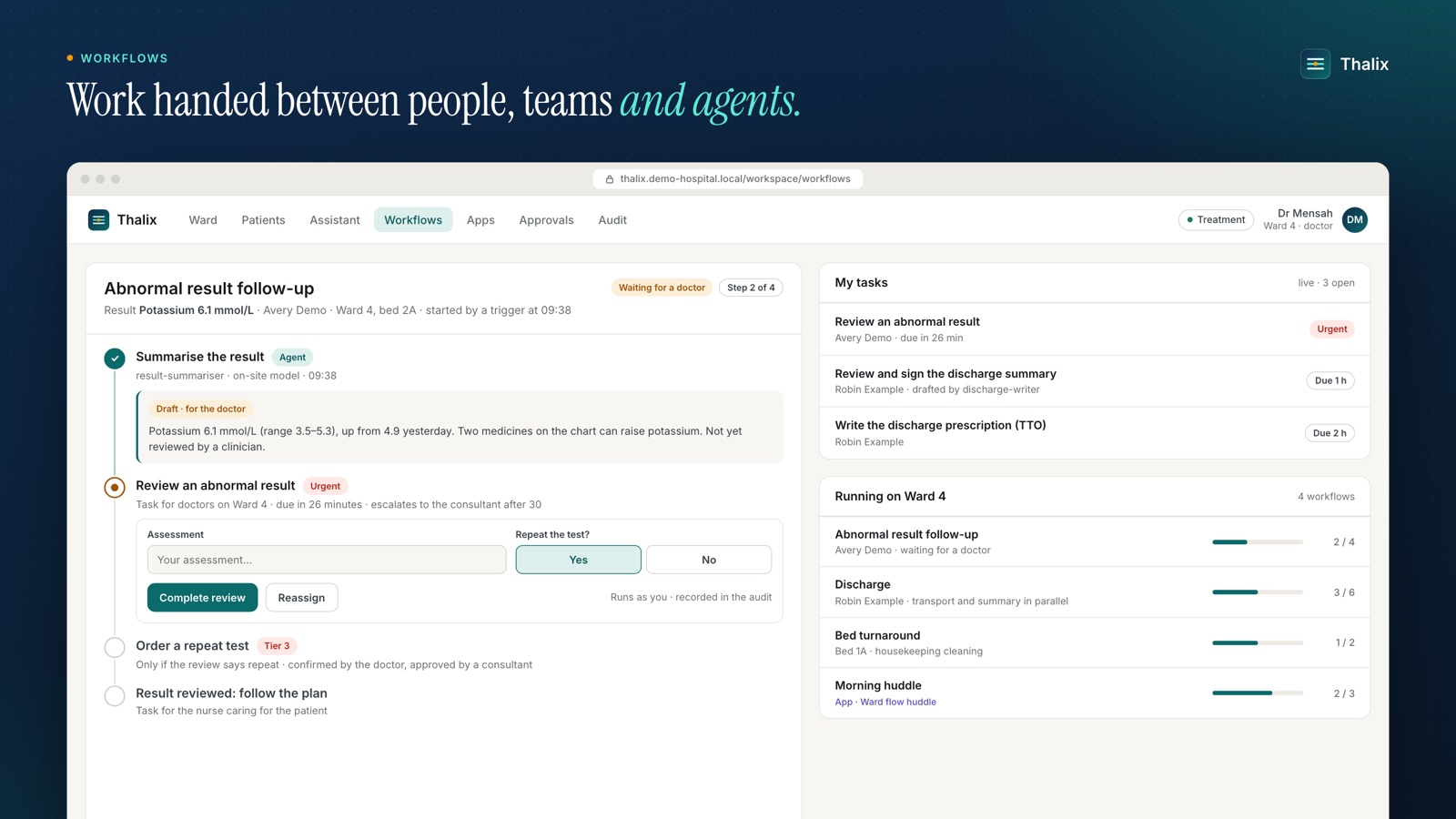
The Thalix home page lists administrative work among the places agents can help (clinical coding prepared for coders, billing and claims checked, referrals triaged against criteria, bookings, reminders and letters), always with a person deciding. In the code, that work runs as workflows: tasks with owners, due times and escalation; agent steps that draft or summarise; and only tier-1 actions run automatically, with everything else confirmed by a person acting as themselves. Data comes in through integration drivers (HL7 v2, FHIR, webhooks, files) rather than screen scraping, and every read and action is audited. These are demos on synthetic data today.
Thalix is at pilot stage. Demos run on synthetic data, and a hospital deployment needs its own clinical safety case, information governance approval and security review. We don't claim any certification or assessment result the product doesn't have.
 See Thalix workingA three-minute walkthrough on synthetic data: the console, agents, workflows and the audit trail →
Questions people ask
What is back-office automation in a hospital?
Software doing repetitive administrative work around care, such as invoice processing, HR forms, data entry between systems, referral processing, bookings, letters and coding support, using RPA, integration or AI.
Should hospitals use RPA or APIs?
NHS England Digital's guidance on authenticating software robots lists "use APIs first" as a principle, with RPA considered only after APIs have been ruled out.
Does AI admin automation need a DPIA?
NHS England's IG guidance says a DPIA must legally be completed before implementing AI-based technologies in health and care.
Sources
Each source below is an official page, read and checked in November 2026. Where a page and this guide differ, the official page wins.
- Robotic process automation and intelligent automation NHS Shared Business Services · checked November 2026
- Secure authentication for robotic process automation NHS England Digital · checked November 2026
- Using AI to improve back office efficiency in the NHS NHS England Digital · checked November 2026
- Artificial intelligence guidance for IG professionals NHS England Digital · checked November 2026
- Major NHS AI trial delivers unprecedented time and cost savings DHSC and NHS England, GOV.UK · checked November 2026
- DTAC form version 2.0, February 2026 (Word) NHS England Digital · checked November 2026
General information only, written for hospital digital, IT, operations and clinical safety teams. It isn't legal, regulatory, information governance or clinical safety advice, and it doesn't replace your own organisation's processes or the official guidance linked above.