AI and hospital operations
Robotic process automation (RPA) in the NHS
Robotic process automation (RPA) uses software robots that operate other applications' screens the way a person would, to automate high-volume, rule-based, repeatable tasks. In the NHS it is widely used for finance, HR, procurement and data entry. NHS England Digital's guidance says robots logging into NHS systems need their own identity, a senior responsible owner who answers for their actions, audited change control, and that APIs should be used first where they exist.
What RPA is good at
NHS England Digital describes RPA as automating "high volume, rule-based, repeatable tasks". It suits work where:
- the steps are the same every time and the rules are written down;
- the inputs are structured (forms, spreadsheets, fixed screens);
- the system involved has no usable API;
- volume is high enough to justify building and maintaining a robot.
NHS Shared Business Services' examples include invoice processing, ESR data keying, offer letters, purchase orders, supplier onboarding, clinical system data entry and referral processing. NHS SBS now describes its service as traditional RPA combined with generative and agentic AI.
The NHS rules for robots that log in
NHS England Digital's page on secure authentication for RPA covers unattended robots signing in through the Care Identity Service. Its main points:
- APIs first. Consider RPA only after APIs have been ruled out.
- Authentication only. Robot identities can't be used to sign or dispense prescriptions, manage authentication tokens or make clinical decisions, and RPA may not automate registration authority functions such as creating users.
- One identity per robot machine, bound one to one to a specific RPA server.
- A senior responsible owner held responsible for the robot's actions.
- Security: the automation cluster in a fully secure location, machine-generated passwords of at least 25 characters held in a vault, credential caching off, supervised entry of robot credentials, and administrative access limited to very few people.
- Audit and change: keep an audit log (it suggests at least 90 days, encrypted), risk-assess each workflow, and put changes through formal, audited change control.
The page is explicit that NHS England doesn't technically assure RPA implementations: decisions sit with the organisation and its SRO. Its tables also give dates for authentication methods being deprecated, so check the current version before you build.
Where RPA breaks
- Screen changes. A robot that clicks through a user interface fails or misbehaves when a supplier updates the screens.
- Exceptions. Anything outside the written rules needs a person; processes with many exceptions automate poorly.
- Hidden dependencies. A robot can become part of a clinical or financial process nobody remembers it is in, until it stops.
- Automating a bad process. Re-keying data between two systems is a symptom; an interface between them removes the work rather than speeding it up.
Alternatives and complements
Where the systems allow it, integration is sturdier: an HL7 v2 feed or FHIR API carries the data without depending on screens, and an integration engine can transform, route and retry it. Where the work involves reading or writing free text, such as letters, summaries or triage notes, AI can draft or suggest, with a person checking. Many organisations end up with a mix: integration for the data, RPA for the one system with no interface, and AI for the unstructured parts.
What it does not mean
- RPA isn't AI. A classic robot follows fixed rules; it doesn't understand the content.
- A robot isn't a user without an owner. NHS guidance requires an SRO responsible for its actions.
- NHS England doesn't approve your robots. It says it won't carry out technical assurance of RPA implementations.
Where Thalix fits
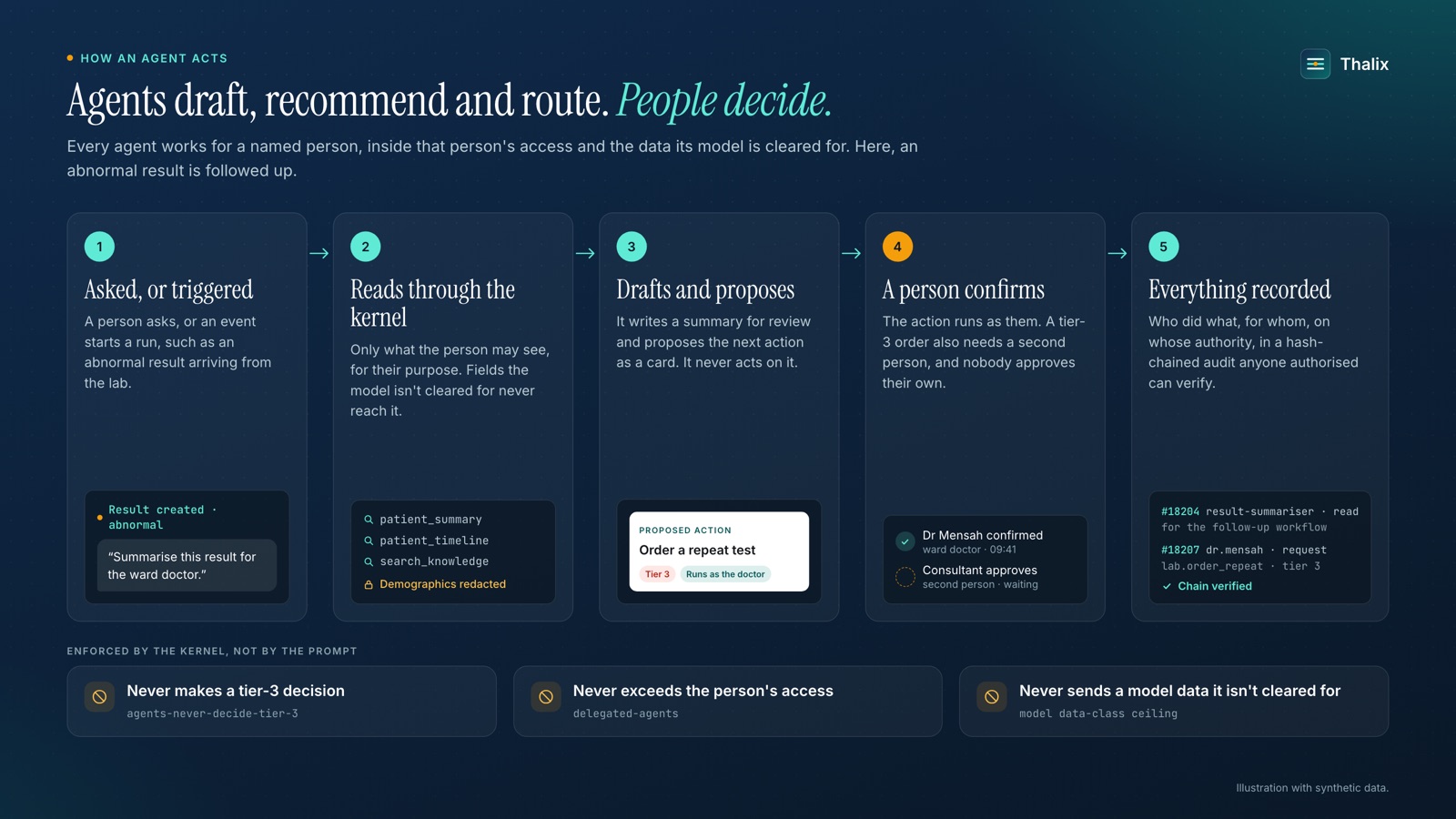
Thalix takes the integration route: drivers receive HL7 v2, FHIR, DICOMweb, webhooks and files, so data arrives through interfaces rather than by robots reading screens. Each agent and workflow has its own identity, every action it takes is audited as itself and the person it acts for, and anything beyond low-risk operational actions waits for a person to confirm. Thalix doesn't drive other applications' user interfaces, so it complements RPA rather than replacing it for systems with no interface.
Thalix is at pilot stage. Demos run on synthetic data, and a hospital deployment needs its own clinical safety case, information governance approval and security review. We don't claim any certification or assessment result the product doesn't have.
 See Thalix workingA three-minute walkthrough on synthetic data: the console, agents, workflows and the audit trail →
Questions people ask
What is RPA in the NHS used for?
High-volume, rule-based tasks such as invoice processing, ESR data entry, offer letters, purchase orders, supplier onboarding, clinical system data entry and referral processing.
Can an RPA robot use a staff member's smartcard?
NHS England Digital's guidance requires one robot identity per RPA machine, bound to a specific server, with a senior responsible owner accountable for the robot's actions.
Does NHS England assure RPA solutions?
No. Its secure authentication guidance says NHS England will not carry out technical assurance of RPA implementations; decisions sit with the organisation and its SRO.
Sources
Each source below is an official page, read and checked in November 2026. Where a page and this guide differ, the official page wins.
- Secure authentication for robotic process automation NHS England Digital · checked November 2026
- Robotic process automation and intelligent automation NHS Shared Business Services · checked November 2026
- Using AI to improve back office efficiency in the NHS NHS England Digital · checked November 2026
General information only, written for hospital digital, IT, operations and clinical safety teams. It isn't legal, regulatory, information governance or clinical safety advice, and it doesn't replace your own organisation's processes or the official guidance linked above.