AI and hospital operations
NHS patient flow software: what it does and how to evaluate it
Patient flow software gives a hospital one live view of beds, patients and discharges, so site teams can match demand to capacity through the day. NHS England's guidance asks hospitals to predict and manage bed demand daily, record the discharge ready date, pathway and reasons for delay consistently in the patient record, share a single view with partners, and make the best use of automated bed systems. Good software supports that work; it doesn't replace the decisions.
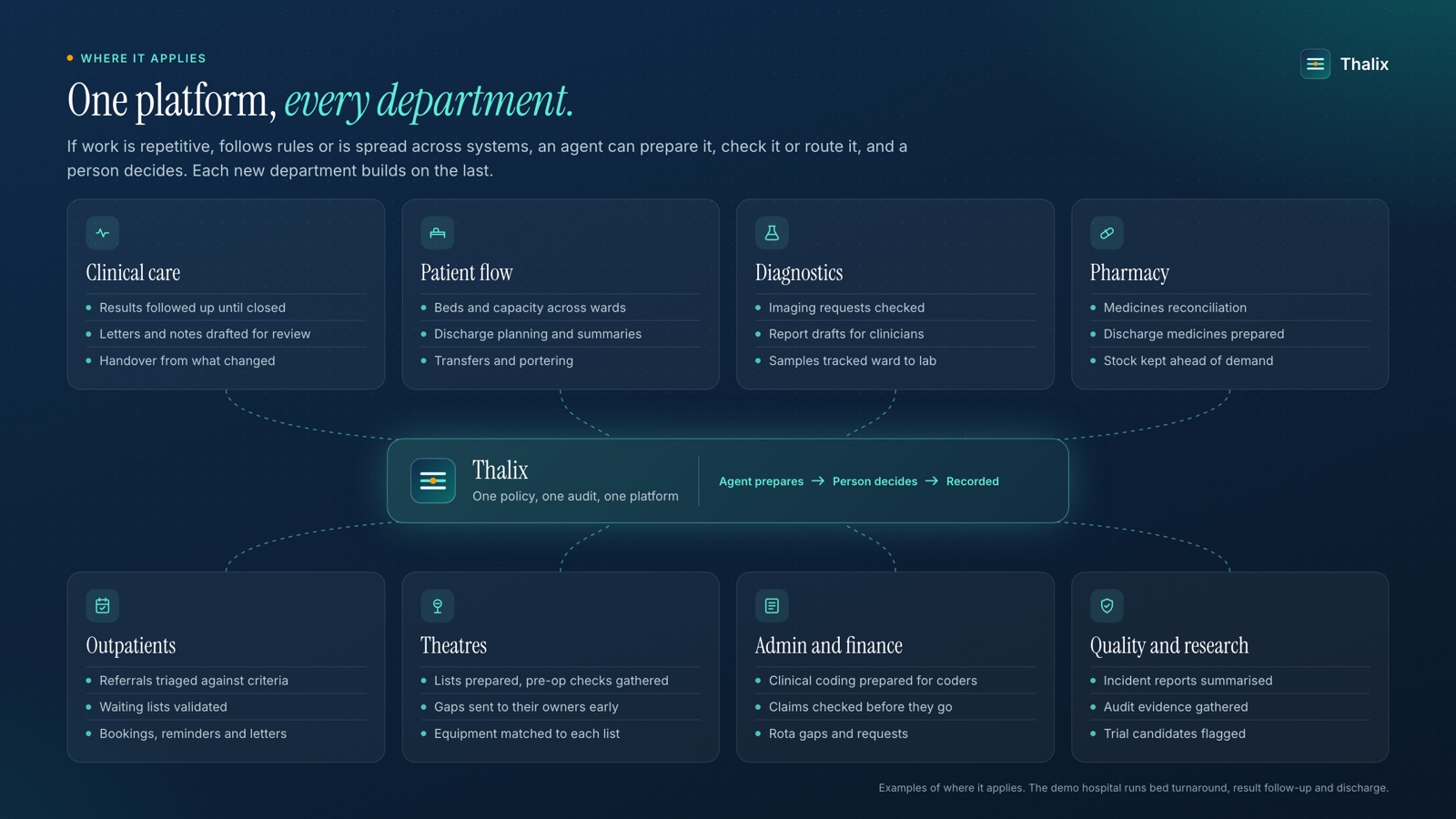
How bed management works in an NHS hospital
NHS England's urgent and emergency care flow guide and its model discharge pathway describe the daily rhythm the software has to support:
- Daily demand and capacity planning. Hospitals predict and manage bed demand and capacity each day, with a consistent number of planned discharges.
- Board and ward rounds. Daily board rounds and ward rounds starting by 10am, with a second afternoon board round to clear what's outstanding.
- Discharge from the start. Discharge planning starts at the point of attendance; criteria-led discharge supports weekends.
- Same day emergency care. SDEC open at least 12 hours a day, 7 days a week in hospitals with a type 1 emergency department.
- Delays with owners. Every delay gets a reason, a named owner and actions, reviewed at senior level.
What NHS England expects the data to show
- The discharge ready date, discharge pathway and reasons for delay, recorded consistently in electronic patient records.
- Discharges required and delivered each day by pathway 0 to 3, visible at ward and site level, and the number of patients ready for discharge, both tracked nationally.
- Measures such as the proportion discharged on their discharge ready date, the average length of delay, beds occupied by patients staying 14 days or more, and discharges before noon. The UEC guide advises against mean length of stay as overly simplistic.
- A single, consistent view of discharge information shared with partners, real-time reporting on a shared data platform, and real-time visibility of community capacity.
What patient flow software does
- Live bed state from the ADT feed, including transfers and cancellations, and from housekeeping and porter updates.
- Boards for wards and the site: who is in which bed, expected discharges, outliers, blocked beds.
- Discharge tasks (medicines to take out, transport, equipment, letters) with owners and due times.
- Delay capture at the moment a planned discharge slips, rolled up for daily review.
- Reporting for the national metrics without re-keying.
Questions to ask before you buy
- Which ADT events does it process, and what happens to one it doesn't understand, such as a cancelled discharge?
- Does it write the discharge ready date and delay reasons back to the EPR, or keep a second copy?
- Can partners and community services see the same view?
- Has the supplier a completed DTAC form for this version? The 2026 form names bed management software as in scope.
- Where is the clinical safety case, and what has it transferred to you under DCB0160?
- Who can see patient names on a shared board, and is every view audited?
What it does not mean
- Software doesn't create beds. It shows demand and delay sooner; capacity still has to exist.
- A discharge event isn't a free bed. Cleaning and allocation are separate steps.
- A dashboard isn't a delay plan. NHS England asks for owners and actions on every delay.
Where Thalix fits
In the Thalix demo, HL7 v2 ADT from a simulated hospital keeps Ward 4's board live, including cancellations. The Discharge workflow runs medicines to take out, transport and a drafted summary in parallel, a doctor signs the summary, and when the patient leaves the bed goes to cleaning; Bed turnaround then asks housekeeping to confirm, frees the bed and escalates after 20 minutes. Boards resolve as the viewer, so a porter and a nurse see different detail, and workflows never see names. It runs on synthetic patients; there is no DTAC form or safety case for it yet.
Thalix is at pilot stage. Demos run on synthetic data, and a hospital deployment needs its own clinical safety case, information governance approval and security review. We don't claim any certification or assessment result the product doesn't have.
 See Thalix workingA three-minute walkthrough on synthetic data: the console, agents, workflows and the audit trail →
Questions people ask
How does NHS bed management work?
Hospitals predict and manage bed demand and capacity daily, run board and ward rounds each morning with an afternoon follow-up, plan discharge from the point of attendance, and track every delay with a reason and an owner, using live bed and discharge data.
What metrics should patient flow software report?
NHS England's model discharge pathway asks for discharges required and delivered each day by pathway 0 to 3, and the number of patients ready for discharge, visible at ward and site level.
Does patient flow software need a DTAC assessment?
The 2026 DTAC form lists software that releases staff time or improves efficiency, such as bed management, as in scope, so buyers should ask for the supplier's completed form.
Sources
Each source below is an official page, read and checked in November 2026. Where a page and this guide differ, the official page wins.
- Model discharge pathway NHS England · checked November 2026
- Urgent and emergency care acute patient flow NHS England · checked November 2026
- DTAC form version 2.0, February 2026 (Word) NHS England Digital · checked November 2026
General information only, written for hospital digital, IT, operations and clinical safety teams. It isn't legal, regulatory, information governance or clinical safety advice, and it doesn't replace your own organisation's processes or the official guidance linked above.