Clinical safety and assurance
The CAF-aligned DSPT: what changed and who it applies to
The CAF-aligned Data Security and Protection Toolkit is the version of the DSPT that larger NHS organisations complete. Since September 2024 it has been built on the National Cyber Security Centre's Cyber Assessment Framework (CAF), with a health and care objective added for information governance. Each outcome is graded Achieved, Partially Achieved or Not Achieved and compared with the minimum levels in the organisation's CAF profile. The 2026-27 toolkit (version 9) is aligned to CAF 4.0 and is due by 30 June 2027.
Who completes the CAF-aligned version
NHS England Digital's guidance names six kinds of organisation:
- NHS trusts and foundation trusts (acute, mental health, community and ambulance).
- Integrated care boards (ICBs) and commissioning support units (CSUs).
- Arm's length bodies of the Department of Health and Social Care.
- Independent health providers designated as operators of essential services under the NIS Regulations 2018.
- Genomics organisations nominated by DHSC.
The first group moved in September 2024; independent providers that are operators of essential services and genomics organisations followed in September 2025. Everyone else, including IT suppliers, GPs, pharmacies, dentists, social care and local authorities, still completes the assertions and evidence items version of the DSPT.
Why it moved to the CAF
The change was a commitment in DHSC's cyber security strategy for health and social care to 2030. The guidance describes the new approach as using principles and expert judgement rather than a fixed checklist. Its stated aims are to put good decision-making ahead of compliance, give local ownership of information risk, and focus on what works rather than ticking boxes. In practice the CAF-aligned DSPT is less prescriptive about what an organisation presents as evidence, with a small number of national directive requirements, the multi-factor authentication policy being one.
How it is structured
The NCSC's contributing outcomes sit under four objectives, and a health and care overlay adds a fifth:
| Objective | Focus |
|---|---|
| A | Managing risk |
| B | Protecting against cyber attack and data breaches |
| C | Detecting cyber security events |
| D | Minimising the impact of incidents |
| E | Using and sharing information appropriately (the health and care addition) |
The DSPT site says the health and care CAF has 47 contributing outcomes: the CAF's 39 plus 8 custom outcomes on using and sharing information. Each outcome has indicators of good practice, which in most cases aren't prescriptive, so organisations can choose how to meet them.
Grades, profiles and statuses
Each outcome is self-assessed as Achieved, Partially Achieved or Not Achieved. An organisation's CAF profile sets the minimum expected level for each outcome, based on the type and size of organisation. The DSPT site is explicit that the CAF isn't designed with an expectation that anyone reaches Achieved on every outcome. To be graded Standards Met, an organisation has to achieve its profile; otherwise it publishes Standards Not Met with an improvement plan, which can move it to Approaching Standards once NHS England and DHSC approve the plan.
Before starting, the guidance asks organisations to scope their essential functions (the information, systems and networks in scope) and to allocate each outcome an owner, usually across the cyber and information governance teams. The senior information risk owner (SIRO) approves the scoping and the final submission.
The yearly rhythm
- Autumn: the new version and its mandatory audit areas are published. Version 9 (2026-27) came out on 2 October 2026.
- By 31 December: an interim assessment, showing the current grade for each outcome. Only confirmation and the date are made public, and it isn't formally assessed for performance management.
- January to May: the independent assessment of a selection of outcomes.
- By 30 June: the full assessment, approved by the SIRO, with an improvement plan if needed.
DHSC, as competent authority under the NIS Regulations, may access the CAF-aligned DSPT information, including independent audit reports.
What it does not mean
- It isn't a pass mark of 100%. Standards Met means achieving your CAF profile, not every outcome at Achieved.
- It isn't for every organisation. IT suppliers, GPs and other smaller organisations still complete assertions and evidence items.
- It isn't the whole of your legal duties. The guidance says the DSPT covers a subset of controls; each legal entity stays responsible for its own obligations.
Where Thalix fits
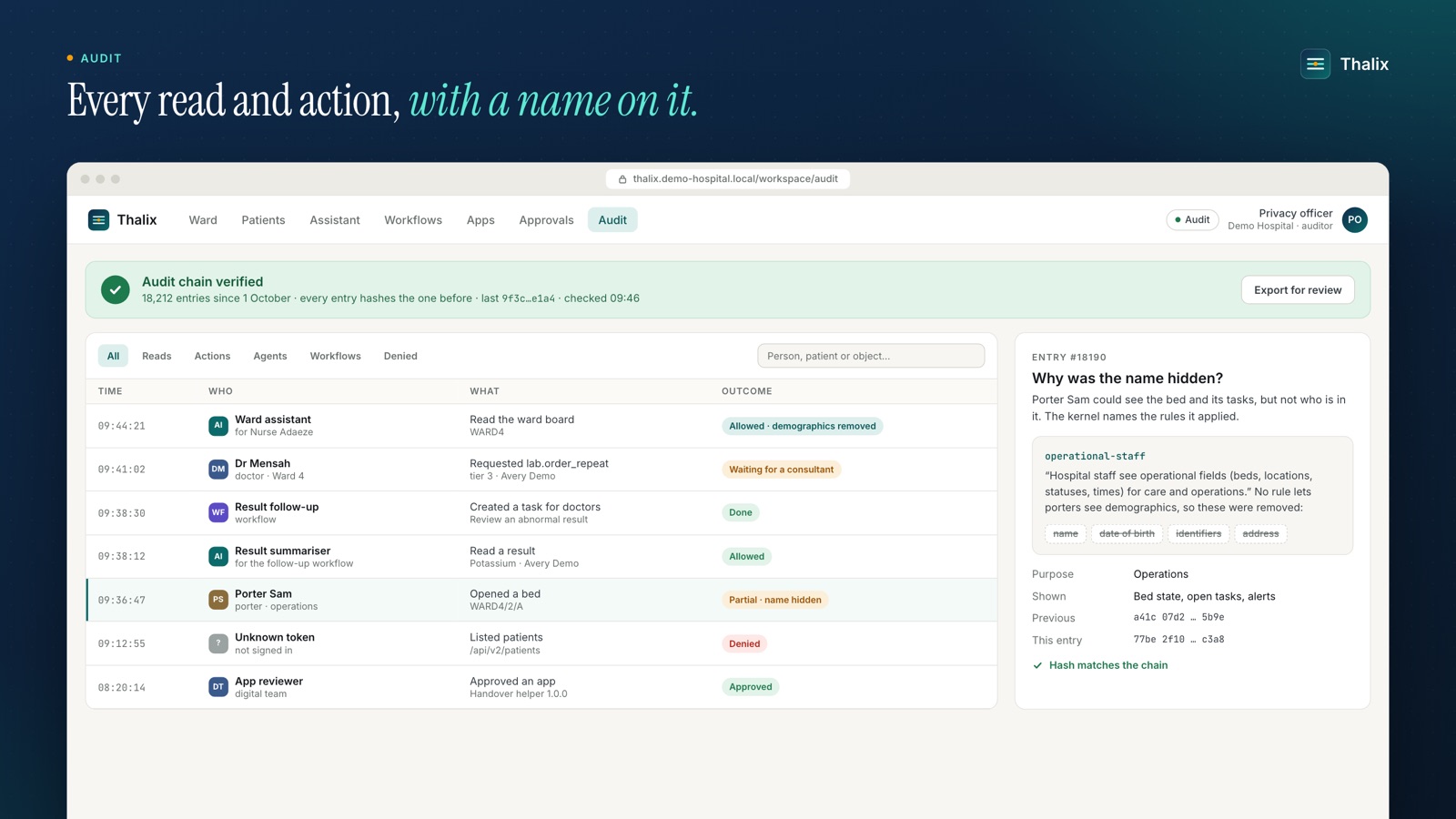
Thalix doesn't hold a DSPT status today; if a pilot gave us access to NHS patient data or systems, we would complete the supplier version. The platform gives a hospital's own CAF evidence concrete things to point at: access decided by role, purpose and care relationship with field-level redaction (B2), time-limited break-glass with a review task (B2), secrets held as references and PHI kept out of logs (B3), and every read, search, action and denial recorded in a SHA-256 hash chain that can be verified (C1). Patient data stays on the hospital's own servers.
Thalix is at pilot stage. Demos run on synthetic data, and a hospital deployment needs its own clinical safety case, information governance approval and security review. We don't claim any certification or assessment result the product doesn't have.
 See Thalix workingA three-minute walkthrough on synthetic data: the console, agents, workflows and the audit trail →
Questions people ask
Who has to complete the CAF-aligned DSPT?
NHS trusts and foundation trusts, ICBs, CSUs, DHSC arm's length bodies, independent providers designated as operators of essential services, and genomics organisations nominated by DHSC. Other organisations complete the assertions and evidence items version.
What is a CAF profile?
The minimum achievement level expected for each outcome, set by organisation type and size. Meeting the profile across all outcomes is what Standards Met requires.
Which CAF version is the 2026-27 DSPT aligned to?
The DSPT says version 9 (2026-27) is aligned to CAF version 4.0. Its deadline is 30 June 2027.
Sources
Each source below is an official page, read and checked in November 2026. Where a page and this guide differ, the official page wins.
- CAF-aligned DSPT guidance: introduction NHS England Digital · checked November 2026
- Independent assessment guide: the CAF-aligned DSPT NHS England Digital · checked November 2026
- Changes to the DSPT for large NHS organisations NHS England, DSPT · checked November 2026
- Outcomes, assertions and evidence items for DSPT 2026-27 version 9 NHS England, DSPT · checked November 2026
- CAF-aligned DSPT interim assessment guidance NHS England Digital · checked November 2026
General information only, written for hospital digital, IT, operations and clinical safety teams. It isn't legal, regulatory, information governance or clinical safety advice, and it doesn't replace your own organisation's processes or the official guidance linked above.