Clinical safety and assurance
How to complete and submit the DSPT, step by step
You complete the Data Security and Protection Toolkit online each year: register your organisation, work through the requirements for your organisation type (CAF outcomes for large NHS bodies, assertions and evidence items for everyone else), have the senior information risk owner or equivalent approve it, and publish it by the deadline. The 2026-27 toolkit (version 9) is due by 30 June 2027. Publishing gives a status: Standards Exceeded, Standards Met, Approaching Standards or Standards Not Met.
Step 1: know which toolkit you're doing
The DSPT publishes two shapes of requirement. NHS trusts, ICBs, ALBs, CSUs, operators of essential services and genomics organisations complete outcomes and indicators of good practice in the CAF-aligned format. IT suppliers (category 2); dentists, local authorities, opticians, pharmacies, social care, universities and others (category 3); and GPs (category 4) complete assertions and evidence items. Download the version 9 requirements from the DSPT news page before you start. Independent healthcare providers complete one toolkit at headquarters or provider level, which can cover several sites under one legal entity and ICO registration.
Step 2: gather evidence early
Evidence items are tailored to the organisation type, and some are mandatory to reach Standards Met. A few drop out depending on your organisation profile: the FAQ says organisations using only NHSmail for secure email need to provide fewer items, and some questions are exempt for holders of Cyber Essentials Plus or an ISO 27001 certificate covering all their health and care data processing. Cyber Essentials Plus itself isn't mandatory.
For an IT supplier, a typical example is assertion 9.2, "a penetration test has been scoped and undertaken". In version 9 its mandatory items ask for an annual penetration test scoped between the SIRO, the business and the testing team (including a vulnerability scan and a check that default passwords on networking components were changed), dated since 1 July 2026, and for the test's action plan with confirmation that the SIRO has reviewed it.
Step 3: interim and audit (large NHS organisations)
CAF-aligned organisations publish an interim assessment by 31 December giving their current grade for each outcome; the SIRO should sign it off. They then have an independent assessment of the mandated outcomes, usually between January and May. IT suppliers also need a DSPT audit to reach Standards Met.
Step 4: approve and publish
The SIRO (or equivalent senior role) approves the final submission, and you publish it in the toolkit by 30 June. Organisations that reach Standards Met or Standards Exceeded can download a certificate. The published statuses are:
- Standards Exceeded and Standards Met: the expected requirements are met.
- Standards Not Met: not every expected outcome or mandatory item is met. You publish anyway and upload an improvement plan through the "Provide an improvement plan" screen.
- Approaching Standards: the status once NHS England and DHSC approve that plan. It becomes Standards Met when every action is complete and reviewed.
Step 5: if you can't meet it, plan
For 2025-26, an improvement plan had to list every outcome not met (including outstanding audit actions), the actions needed, milestones including funding and resourcing, an owner, a priority, local references and a completion date for each action. Plans with dates beyond June 2027 weren't agreed without exceptional circumstances, and progress updates were due by 30 September and 31 December 2026. Organisations expecting to miss the standard were asked to contact the DSPT team before the deadline.
What it does not mean
- The DSPT isn't needed to connect to HSCN. NHS England says a DSPT assessment isn't necessary to gain access to the Health and Social Care Network, but every organisation using HSCN signs a Connection Agreement, and national applications on it such as PDS and e-RS still require a DSPT assessment.
- Missing the standard isn't the same as not publishing. Organisations that don't meet it publish Standards Not Met with an improvement plan.
- Last year's status doesn't carry over. The toolkit is completed every year against that year's version.
Where Thalix fits
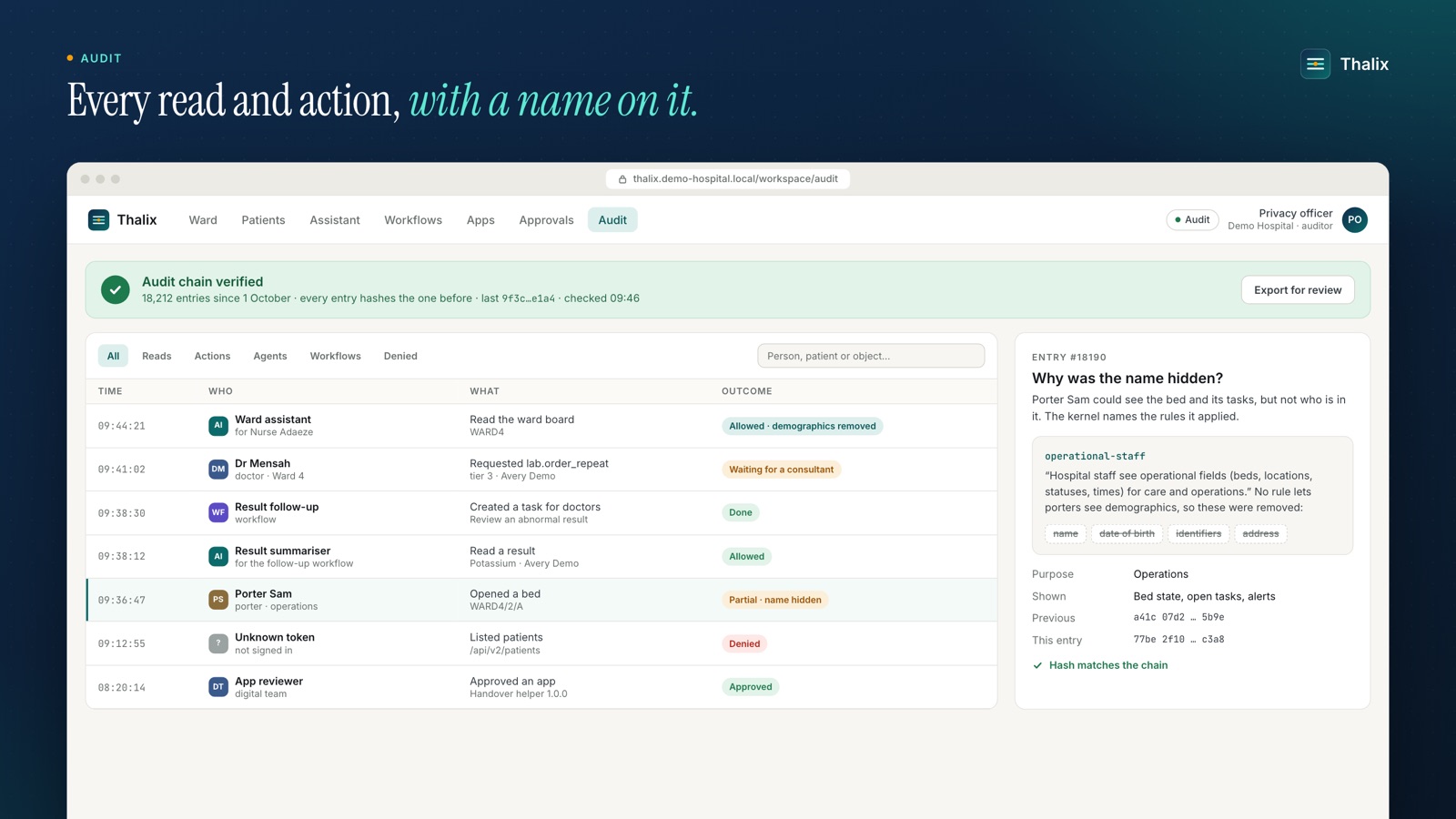
For the IT supplier version, Thalix's own security notes already list what a hospital deployment needs: a clinical safety case, information governance approval and penetration testing. The design helps with several evidence areas a hospital or supplier is asked about: TLS 1.2/1.3 and mutual TLS on any network listener, key files refused if world-readable, bearer tokens compared in constant time, secrets held as references rather than in config, PHI kept out of logs, and audited, reason-stated reveals of raw messages. Thalix hasn't published a DSPT assessment; it would do so before handling NHS patient data.
Thalix is at pilot stage. Demos run on synthetic data, and a hospital deployment needs its own clinical safety case, information governance approval and security review. We don't claim any certification or assessment result the product doesn't have.
 See Thalix workingA three-minute walkthrough on synthetic data: the console, agents, workflows and the audit trail →
Questions people ask
When is the DSPT submission deadline?
The 2026-27 toolkit (version 9) must be published by 30 June 2027. Large NHS organisations also publish an interim assessment by 31 December.
Who approves the DSPT submission?
For CAF-aligned organisations, the senior information risk owner (SIRO) approves the scoping of essential functions and the final submission. Supplier and smaller-organisation evidence items refer to the SIRO or equivalent senior role.
Do you need the DSPT to connect to HSCN?
No. NHS England says a DSPT assessment isn't necessary to gain access to HSCN, though organisations sign a Connection Agreement and national applications such as PDS and e-RS still require a DSPT assessment.
What is DSPT assertion 9.2?
In the supplier and smaller-organisation toolkit, 9.2 is "a penetration test has been scoped and undertaken". For IT suppliers in 2026-27 it asks for an annual, SIRO-scoped penetration test since 1 July 2026 and a reviewed action plan.
Sources
Each source below is an official page, read and checked in November 2026. Where a page and this guide differ, the official page wins.
- Outcomes, assertions and evidence items for DSPT 2026-27 version 9 NHS England, DSPT · checked November 2026
- DSPT 2026-27 assertions and evidence items, categories 2 to 4 (v1.1, spreadsheet) NHS England, DSPT · checked November 2026
- DSPT frequently asked questions NHS England, DSPT · checked November 2026
- Improvement plans: instructions for 2025-2026 NHS England, DSPT · checked November 2026
- Connecting to HSCN NHS England Digital · checked November 2026
General information only, written for hospital digital, IT, operations and clinical safety teams. It isn't legal, regulatory, information governance or clinical safety advice, and it doesn't replace your own organisation's processes or the official guidance linked above.