Clinical safety and assurance
The DSPT audit (independent assessment) explained
The DSPT audit is an independent assessment of an organisation's Data Security and Protection Toolkit. For the CAF-aligned toolkit it tests a selection of outcomes between January and May and gives two outputs: an overall risk rating for the organisation's information security and governance controls, and a confidence level in how accurate its own self-assessment is. For 2026-27, NHS trusts, ICBs and the other large organisations audit 11 mandated outcomes plus one of their choice.
What has to be audited in 2026-27
The DSPT published the areas of mandatory audit on 1 October 2026. For NHS trusts, ICBs, arm's length bodies, CSUs, operators of essential services and genomics organisations, the 11 mandated outcomes are:
| Outcome | Topic |
|---|---|
| A1b | Roles and responsibilities |
| A3a | Asset management |
| B2c | Privileged user management |
| B2d | Identity and access management |
| B3a | Understanding data |
| B4c | Secure management |
| B6a | Culture |
| B6b | Training |
| C1e | Personnel skills for monitoring and detection |
| D1c | Testing and exercising |
| E4a | Managing records |
Each organisation adds one outcome of its choice. Suggestions are D1a (response plan) for trusts, ICBs, ALBs and CSUs, B5c (backups) for operators of essential services and genomics, and A2a (risk management process) for critical national infrastructure operators. The board should approve the scope.
IT suppliers are audited too, on 12 assertions from the supplier toolkit: 1.1, 2.2, 3.1, 3.2, 4.1, 6.2, 7.1, 8.1, 8.2, 9.2, 9.6 and 10.2. The DSPT FAQ says IT suppliers must complete a DSPT audit to reach Standards Met even if they hold ISO 27001 or Cyber Essentials Plus, though those certificates can narrow the audit.
The two outputs
NHS England's guide for independent assessors says every assessment produces:
- An overall risk rating for the organisation's security and governance of information: very high, high, moderate, low or very low, worked out as likelihood times impact.
- A confidence level in the self-assessment: high where there is little or no deviation from what the organisation declared, medium where the deviation is non-trivial, and low where it is large, for example Standards Met declared while several outcomes were not achieved.
Each outcome tested is also graded Achieved, Partially Achieved or Not Achieved. The guide asks assessors to judge controls on their effectiveness in meeting the outcome, not on whether a document exists.
How an assessment runs
- Preparation: confirm the provider and review prior evidence and audits.
- Scoping: agree the outcomes and terms of reference, signed off by the sponsor.
- Fieldwork: document review, interviews and sample testing.
- Reporting: a close-out meeting, then a draft report about two weeks later. Management responds within two weeks, with owners and target dates, and the final report follows within a week. The guide's principle is "no surprises": findings are discussed before the draft goes out.
- Follow-up: recommendations are tracked. The final report goes to the audit and risk committee at its next quarterly meeting.
Choosing an assessor
NHS England encourages organisations to choose assured providers from the NCSC's Cyber Resilience Audit scheme or equivalent, and says assessments should be done by qualified assessors experienced in the CAF. The organisation manages conflicts of interest before contracting. Outcomes are covered over several years, so a selection is tested each year rather than all 47 at once.
What it does not mean
- An audit isn't a status. The status (Standards Met, Approaching Standards and so on) comes from the published self-assessment; the audit says how far that can be trusted.
- Low confidence isn't a fail of the toolkit. It means the self-assessment and the evidence disagree, which the organisation should then correct.
- A certificate isn't a substitute. ISO 27001 or Cyber Essentials Plus may narrow an IT supplier's audit, but the FAQ says the audit is still needed.
Where Thalix fits
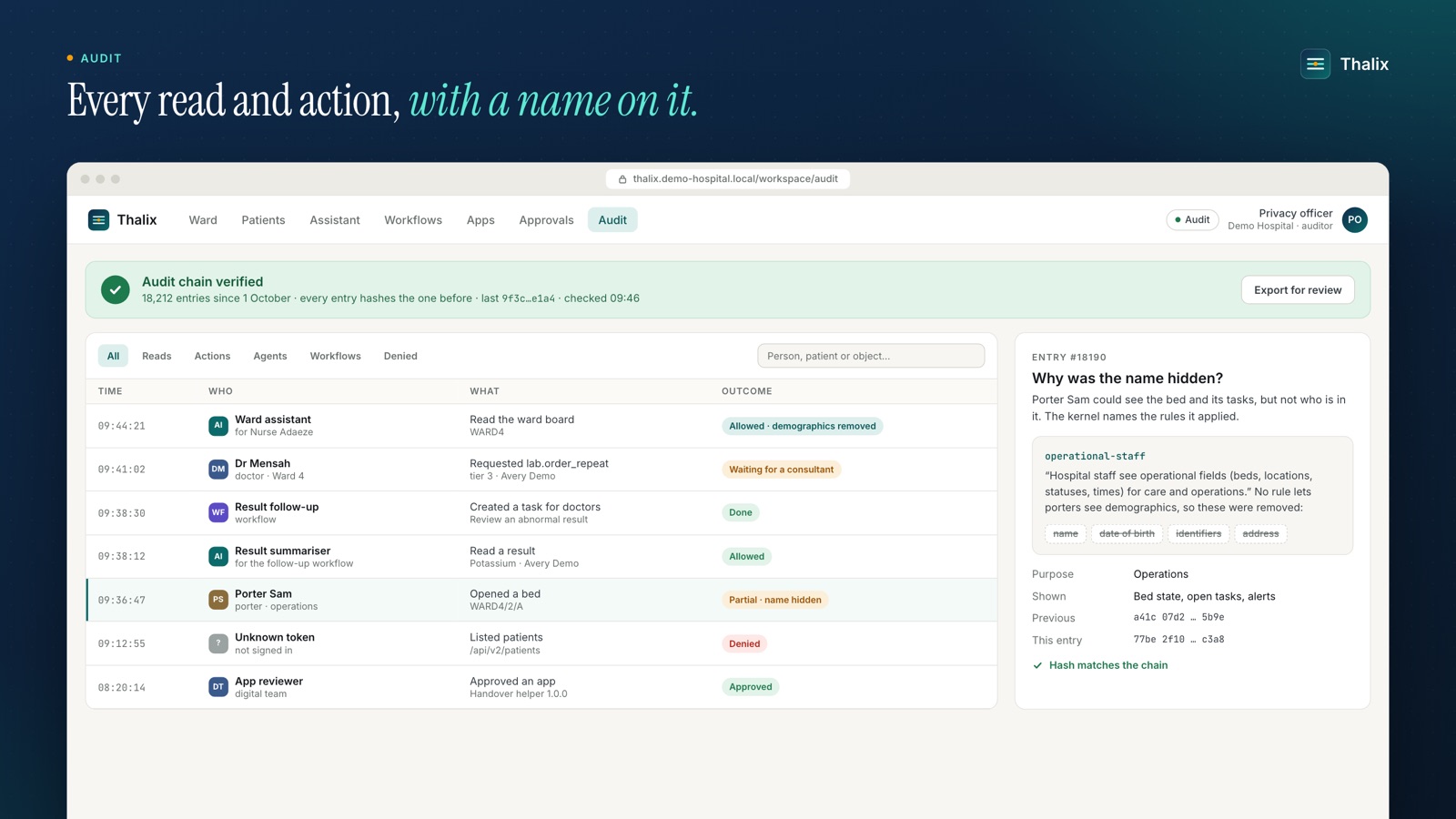
Several mandated outcomes are about who can reach what and whether anyone would notice: B2c privileged users, B2d identity and access, C1e monitoring. In a Thalix deployment those questions have a record to test against. Access is decided by policy (role, purpose of use, unit and care-team relationships) and the explain call shows which rule decided it. Admin actions, raw-message reveals (with a stated reason), merges and dead-letter operations are audited, and every kernel read and action sits in a hash chain an assessor can verify. Thalix has no DSPT audit result of its own today.
Thalix is at pilot stage. Demos run on synthetic data, and a hospital deployment needs its own clinical safety case, information governance approval and security review. We don't claim any certification or assessment result the product doesn't have.
 See Thalix workingA three-minute walkthrough on synthetic data: the console, agents, workflows and the audit trail →
Questions people ask
When does the DSPT audit happen?
NHS England's planning guidance says the independent assessment of the CAF-aligned DSPT is conducted between January and May, ahead of the 30 June deadline.
How many outcomes are audited in 2026-27?
Twelve for NHS trusts, ICBs and the other large organisations: 11 mandated outcomes plus one of their choice. IT suppliers have 12 listed assertions.
What does the confidence level in a DSPT audit mean?
It's the assessor's view of how accurate the organisation's own self-assessment is: high (little or no deviation), medium (non-trivial deviation) or low (high deviation).
Do IT suppliers need a DSPT audit?
The DSPT FAQ says IT suppliers must complete a DSPT audit to achieve Standards Met, even with ISO 27001 or Cyber Essentials Plus, though those can reduce its scope.
Sources
Each source below is an official page, read and checked in November 2026. Where a page and this guide differ, the official page wins.
- DSPT audit 26-27: areas of mandatory audit NHS England, DSPT · checked November 2026
- Guide for CAF-aligned DSPT independent assessors NHS England Digital · checked November 2026
- Next steps: planning for your review NHS England Digital · checked November 2026
- Overview of the independent assessment framework and guide NHS England Digital · checked November 2026
- DSPT frequently asked questions NHS England, DSPT · checked November 2026
General information only, written for hospital digital, IT, operations and clinical safety teams. It isn't legal, regulatory, information governance or clinical safety advice, and it doesn't replace your own organisation's processes or the official guidance linked above.